


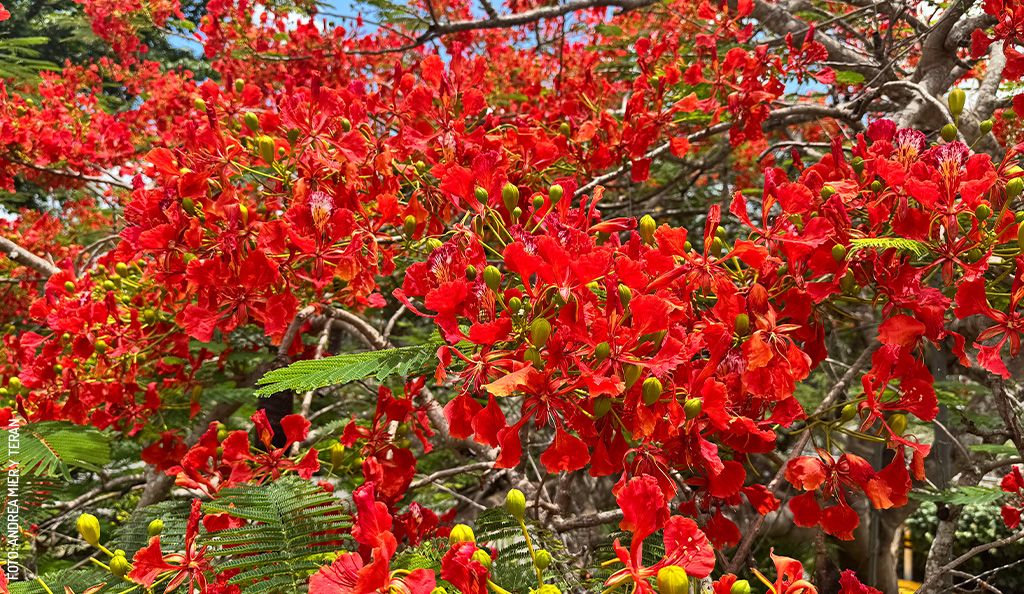
Every June, the landscape of Yucatán undergoes a breathtaking transformation. This is the season when the Flamboyan tree (Delonix regia) ignites the horizon with intense shades of crimson. Reaching toward the sky and carpeting the ground in a velvet layer of fallen petals, it creates one of the most iconic vistas in Southeast México.
Although it is now a cornerstone of regional identity—immortalized in poetry, music, and the scenery of gardens and historic haciendas—its history in Maya lands is surprisingly recent, beginning just 150 years ago.
Origin and Etymology: From Madagascar to the Mayab
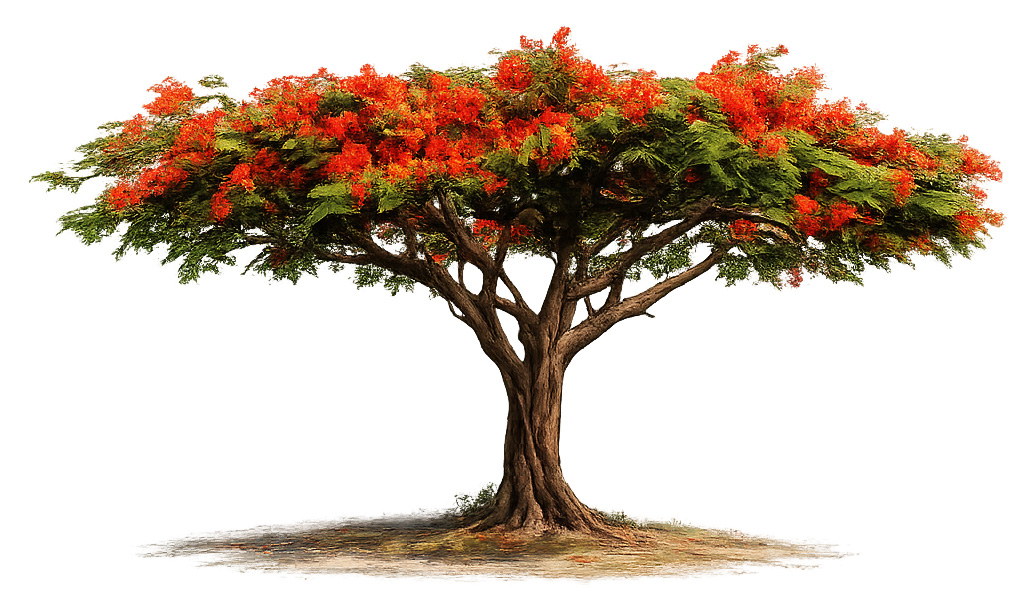
Despite its seamless adaptation to the tropical climate of the Yucatán Península, the flamboyán is native to Madagascar. This striking tree can reach up to 12 meters in height and is easily recognized by its wide, umbrella-like canopy and vibrant blossoms.
In English, the flamboyán is known as royal poinciana, flame tree, or, conveniently, flamboyant. While its official Spanish name is framboyán, the word took on a life of its own in the Yucatán Península. Many Maya speakers call it the plamboyán—a fascinating linguistic quirk arising because the "F" sound does not exist natively in the Maya language, leading speakers to naturally substitute it with a "P."
Bringing the "Fire" to Mérida
The flamboyán arrived in Yucatán via Cuba. In his 1950 work Reconstrucción de hechos, writer Eduardo Urzaiz Rodríguez (under the pen name Claudio Mex) details its arrival:
"The first flamboyanes to bloom in Mérida were those planted in Azcorra by Don Manuel Cirerol in 1876 (here, Azcorra refers to the San Diego Azcorra hacienda, now a neighborhood in Mérida near the Kukulkán Sports Complex).
"The seeds were brought from Havana by Don Félix Martín Espinosa. While some local writers have imagined romances between Maya princesses and Itzá warriors beneath a flowering flamboyán, this beautiful tree actually originates from East Africa. The French brought it to the Antilles, from where it spread to Cuba, and finally to Yucatán."
Urzaiz concludes: "Upon seeing their red bloom […] the poet Javier Santamaría once exclaimed: 'There is no doubt, God is a painter!'"
A Tradition of Flowers
In Yucatán, an ancient tradition sees young girls offering plumeria flowers (Flor de Mayo) to the Virgin Mary throughout the month of May. However, in the 20th century, after a particularly turbulent era in Mexican history, a parallel tradition emerged in June: young boys began gathering flamboyán flowers to honor the Sacred Heart of Jesus.
An everlasting icon on every corner
By the late 1890s, local authorities began using the flamboyán to landscape public spaces. Originally common in the estates of the henequén (sisal) growing regions, the trees soon spread to remote municipalities like Tekal de Venegas, Seyé, and Dzoncauich. To this day, these majestic trees stand at the entrances of towns, welcoming visitors with their sprawling shade.
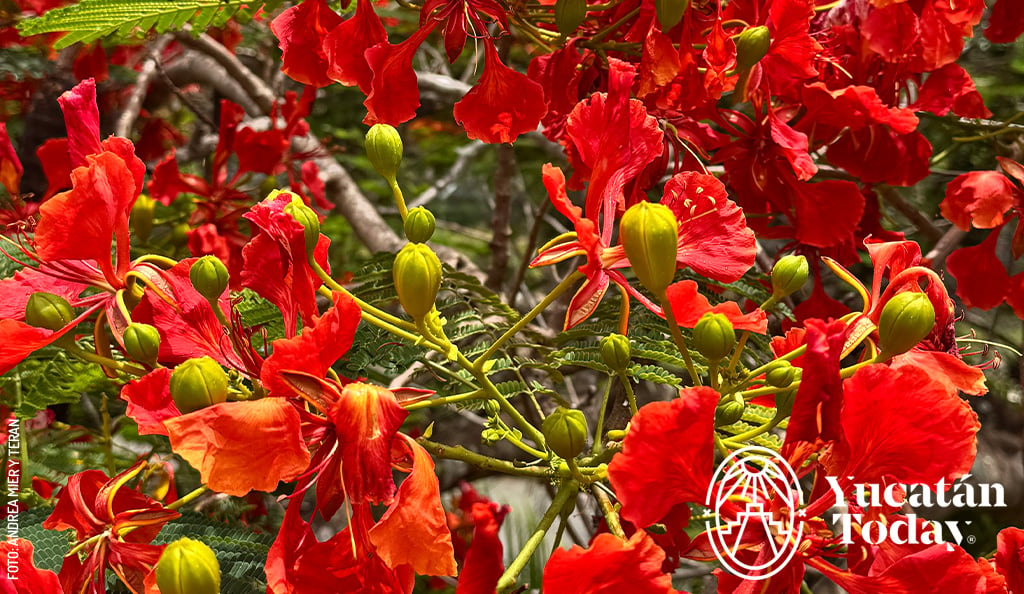
The image of a blooming flamboyán often serves as a metaphor for passionate love in local art. In the 1960 song Flamboyán del camino, Luis Espinosa Alcalá wrote that its "red petals are made of the blood of my faithful heart." Similarly, Lía Baeza Mezquita’s 1973 song Me lo dijo Dios describes a "rain of fire in the flamboyanes, fire that inflames my heart."
Today, these trees are found everywhere—from small village squares to vast ranch estates and quiet roadsides. Since 1878, the flamboyán has been fully naturalized, remaining a favorite for the people of Yucatán, and offering cool relief to anyone who seeks shelter beneath its leafy branches.
Editor’s note: Modern urban planning recommends avoiding planting flamboyanes on streets or sidewalks, as their shallow, aggressive root systems are known to lift concrete. Additionally, their wood is susceptible to woodworms, which can weaken the trunk and make the trees prone to falling.
First published in Yucatán Today print and digital magazine no. 462, in June 2026.


Related articles


