


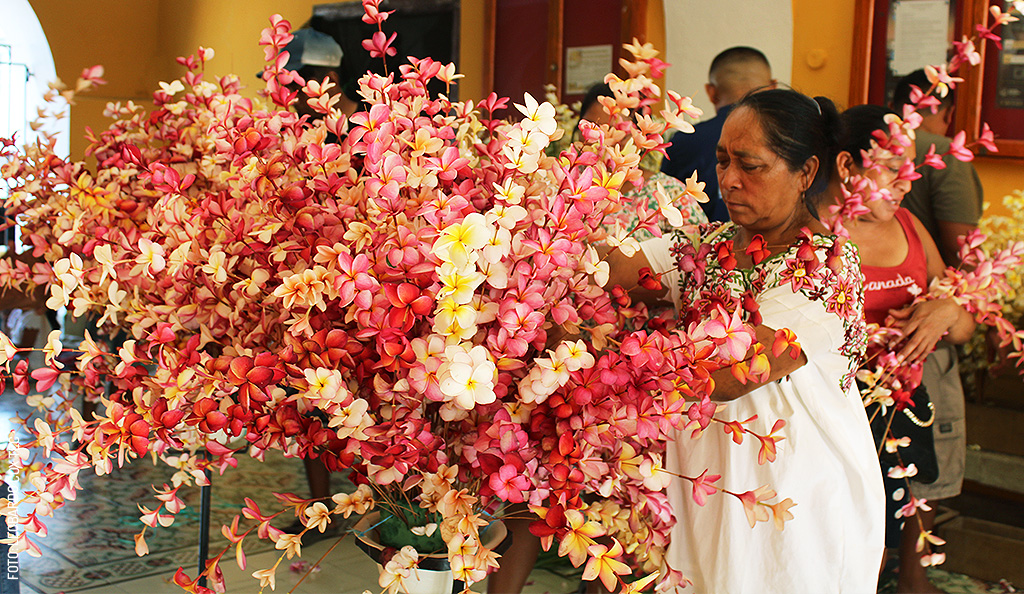
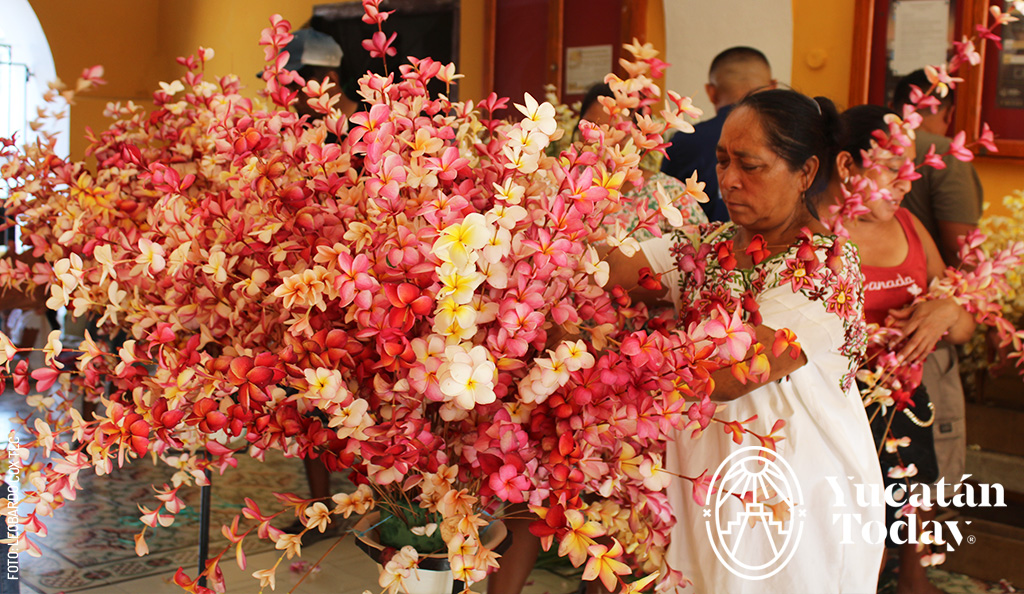
Throughout May, most Maya towns preserve the tradition of the "presentation of flowers." This involves bringing flor de mayo (plumeria or frangipani flowers) to the local church as a solemn offering to the Virgin Mary. The presentation of flowers is a tradition of European origin that the Maya adopted by linking the nikte’ (May flower) to the Virgin.
Plumeria, an ancestral flower
The flor de mayo (Plumeria rubra), or nikte’ in the Maya language, has been revered by the Maya since pre-Hispanic times. In the Dresden Codex, for example, we can see images of the god Kiimil (the Maya god of death) and the god Itzamna’ (the god of the sky) holding the glyph for nikte’ in their right hand. The omen for the first one reads “Kiimil receives flowers, the omen is mortality.” Over Itzamna’, the text goes “Itzamna’ ate flowers.” Offering May flowers to the gods must have been very common back then.
During the Colonial era, nikte’ was also associated with erotic love, lust, and fertility. An ancient way to refer to marriage in Maya was k’am nikte’ (to receive the flower). The Songs of Dzitbalché mention a ritual called k’ay nikt’e: “the song of the flower or the song of love, a secret rite for women to attract their loved one.” Nikte’ was also an obscene way to refer to female genitalia, and julnikte’, “crossing the flower,” a vulgar way to refer to sex.
In the Books of Chilam Balam, several female deities associated with the nikte’ flower are mentioned, such as Ix Bolón Yol Nicté (the nine heart plumeria) and Ix Dziban Yol Nicté, (the painted heart plumeria). At some point during colonial times, this flower, once linked to earthly passion, became the supreme offering for the Virgin Mary.
The presentation of flowers to Our Lady of Tetiz
In Tetiz, in western Yucatán, the presentation of flowers has become the largest and best-organized in the state. Every day in May, thousands of flowers are offered to the Virgin of Tetiz.
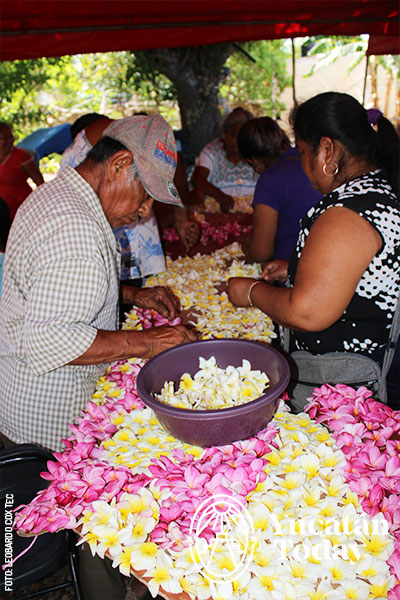
Each night, a different family (known as nocheros) creates monumental and colorful decorations for the altar, which are set promptly at 5 pm. Before the flowers are taken to the church, a luncheon is organized for participants, and the women gather to carry out the julnikte’ (flower threading). They meticulously string the blossoms onto coconut palm leaf sticks. Once the flowers are presented, a rosary is prayed; the ritual concludes with a Mass, mariachi or charanga music, and the traditional "toritos" (firework frames) in front of the church.
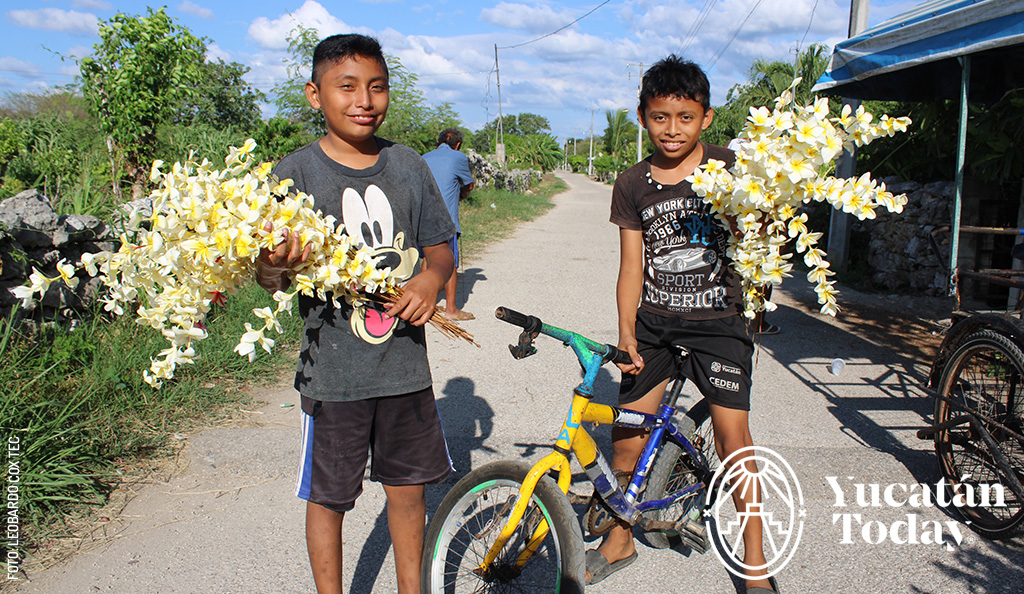
This beautiful offering is a true act of faith, as it involves a lot of responsibility and commitment that are often part of a manda (a sacred promise made in exchange for a special favor or miracle). Collecting the flowers alone requires extreme care, often picking them one by one to protect future blooms. Once picked, they must be stored in cool, damp rooms to withstand the intense heat of México. An entire room is devoted to keeping them—the floor is lined with cardboard and the flowers are constantly sprayed with cold water to keep them from wilting.
Visiting Tetiz in May is a chance to witness the devotion and artisanal heritage of a community honoring one of the most important religious icons in Yucatán. Only 36 kilometers (22 mi) west of Mérida, Tetiz and its traditions await—and you can be sure the locals will be happy to show them off.
Our Lady of Tetiz
Also known as “La Pobre de Dios” (God’s Poor Woman), the Virgin of Tetiz has gathered generations of faithful followers, not only in Tetiz but throughout various corners of Yucatán. Although the original patron saint of the church in Tetiz was Saint Bernardino of Siena, devotion to Our Lady of Tetiz quickly overshadowed him. Her pilgrim image, a representation of Our Lady of the Assumption, has strengthened the faith of entire communities that welcome her with devotion, opening their homes and hearts to ask for comfort, protection, and hope.
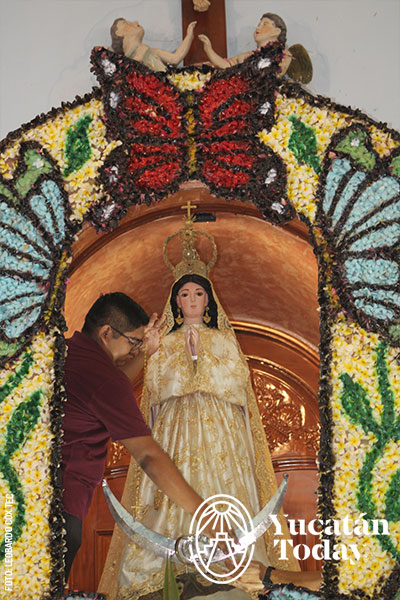
As with many religious icons in Yucatán (such as the Black Christ of Sisal or the Christ of the Blisters in the Mérida Cathedral), the origin of the Virgin of Tetiz is surrounded by legend. The most well-known story takes place on a cold December morning at the convent of Our Lady of Loreto in Seville, Spain.
According to Bishop Crescencio Carrillo y Ancona, one day a beggar woman arrived at the monastery—unknown, dressed in poverty yet of striking beauty—asking for alms to rebuild her home, which she said was in ruins. Moved by her plea, Friar Francisco de San Buenaventura, the superior of the convent, gave her his last coin. Grateful, the woman told him that one day he would be the one to build a house for her and her son. From that day on, she was never seen again.
Fourteen years later, Friar Francisco arrived in Yucatán as a bishop. While visiting the towns under his care, he came upon the village of Tetiz, where the church was in poor condition: dilapidated, in ruins, and with an unusable palm-thatched roof. Upon entering, he was astonished to find an image of the Virgin: “Here is the beggar of Loreto!” The features of the sculpture were the same as those of the mysterious woman who had once asked for charity. His amazement grew when he discovered that the image held the very coin he had given her, recognizable by its markings and date.
The promise was fulfilled, and the friar rebuilt the house of the poor woman: he erected the church of Tetiz in the mid-18th century, including a small chapel that would become one of the most visited sanctuaries in the Península.
To this day, the Virgin of Tetiz draws thousands of devotees; so much so, the Virgin has to travel throughout the year to towns like Sisal, Hunucmá, Texán, and Kinchil, so everyone gets a chance to see her up close. After each of her visits, she leaves a bond of shared prayers, fulfilled promises, and a deep faith that unites many Yucatecan families and people from all walks of life who seek her blessing.
By Leobardo Cox Tec and Sharon Cetina, with information by Crescencio Carrillo y Ancona.
First published in Yucatán Today print and digital magazine no. 461, in May 2026.


Related articles


