

Intoxicating beverages have always been a part of traditional celebrations in Yucatán. For today's Maya, these drinks constitute important offerings to maintain a close relationship with the divine and serve as protection, as they ward off evil spirits.
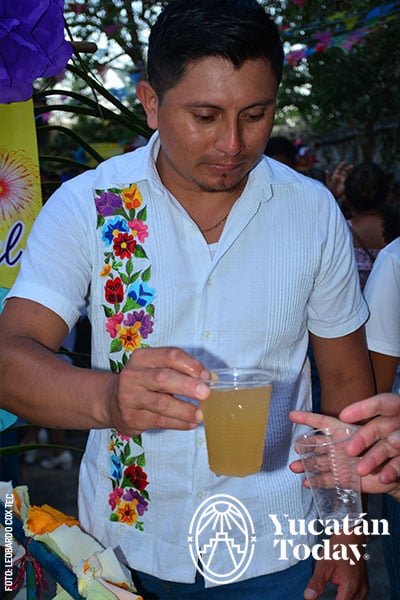
During the festivities of the Christ of the Transfiguration in Chumayel—held between April and May—large quantities of a spirit called birinxíich’ are shared. This drink consists of a mixture of grapefruit soda, cane liquor, mineral water, and ice. For the primicia, or main offering of the Gremio de la Alborada, the birinxíich’ is made with coconut water and is handed over to the family that will be in charge of organizing next year's party.
This mixed drink has undergone various changes, the main one being the substitution of cane liquor for different types of spirits that people donate as a "promise" (promesa) to the Holy Christ, which can include vodka, tequila, whiskey, mezcal, or rum. Any or all of these liquors are mixed in buckets with soda, juice, or mineral water and ice to be given away to anyone who wishes.
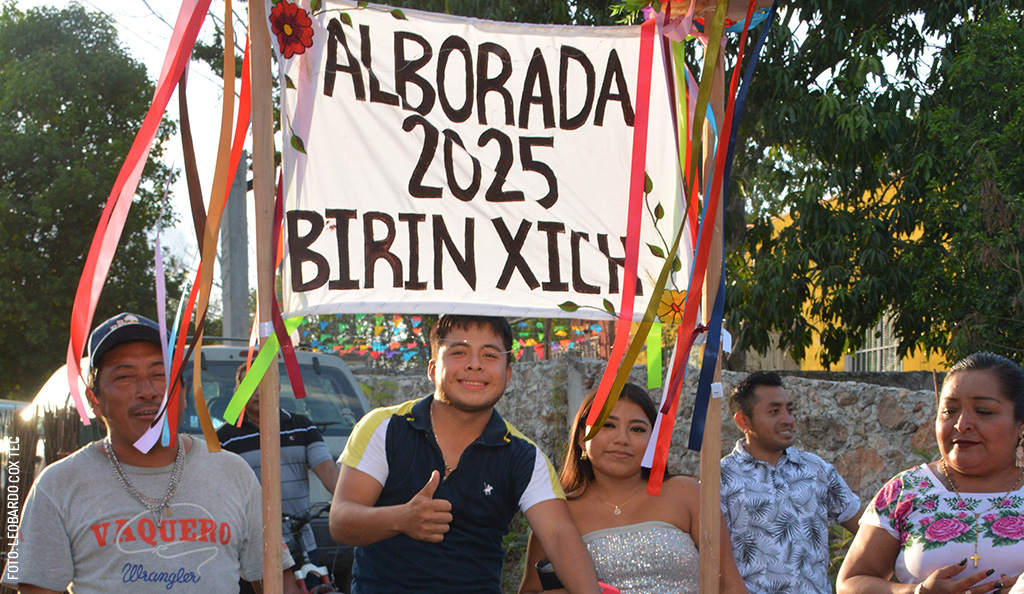
Birinxíich’ can be gifted on any day of the festival, but it takes center stage on April 23rd, during the collection of the pig heads (cabezas de cochino) during the Alborada. A committee carries large quantities of ingredients on decorated tricycles to ensure it doesn't run out, filling the glasses of attendees to quench their thirst along the route.
The birinxíich’ helps men and women enter a state of trance that brings them closer to the divine and, in turn, cleanses the k’ak’aas ik’o’ob: the "bad airs." Flora Canché Briceño, a native of Chumayel, mentions that elders used to mix anise liqueur to celebrate the feast and made a play on words in the Maya language:
“ku xa’ak’ta’al le anís, utia’al u k’imbesaj le cha’ano’ […] chéen ba’ale’, tuláakal a xíich’elo’ob ku xa’ak’ta’al xan” (The anise is mixed to brighten the party […] but your tendons also get sore).
This báaxal t’aan, or wordplay, makes sense because when the birinxíich’ is given out, people are running behind the pig heads; thus, the tendons in their knees get "tied up" from exhaustion. The alcoholic drink helps to "unravel" them.
Why is it called birinxíich’?
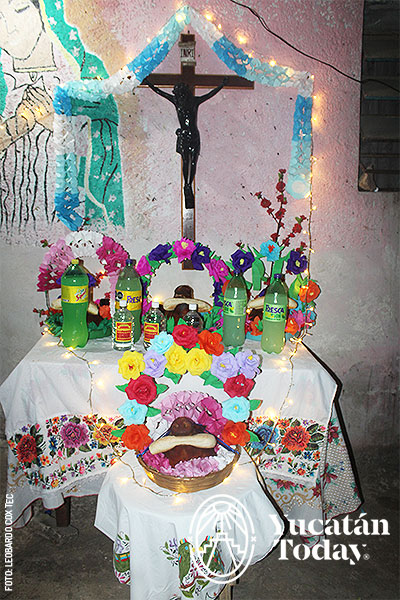
Birinxíich’ is not exclusive to Chumayel, although it is where it is prepared in the largest quantities; its name can also vary by region. In Yaxcabá, in the east of the state, it is called wak’, waaro, or chakpool; in Tabi, Sotuta, it is called xbok’; and in Sahcabá, it is known as birinxúuch or bilinxúuch, which seems to be the oldest form of the word. In this case, birinxúuch can be translated as “to sip it all” or “to sip many times.”
Birinxíich’ seems to be a modern Maya word, as it is not recorded in any ancient dictionary. Therefore, although it has no direct translation, some translate it as “to tie everything,” “all the tendons” (referring to how tendons "tie up" when drinking), or “bare tendons” (referring to the tendons being "stripped" when consumed).
Asking around liquor stores in various municipalities, several people mentioned a fine drink that began to be sold in Mérida in the early 2000s called “Birichino.” Although this turns out to be an Italian wine brand, birinxíich’ could also be a corruption of this name.
Other curiously named drinks in Yucatán
This wouldn't be the first time this has occurred. For example, the traditional drink consumed during the festivities of Hunukú, Yucatán, is called mistela. The original mistela is a European drink made from grape must mixed with wine alcohol to prevent fermentation; however, in Hunukú, it is prepared from anise liqueur, honey, Tabasco pepper, anise seeds, and cinnamon, simmered over low heat. Similarly, in Xocén, south of Valladolid, a drink made from locally harvested coffee ground with Tabasco pepper and star anise is called "Nescafé."
First published in Yucatán Today website in March 2026.


Related articles


