


When Language Becomes Territory: A look at the Bienal Yucatán (Yucatán Biennial)
Did you know that one of the most ambitious contemporary art projects in México is about to take place right here in Yucatán? From November 2026 to February 2027, the Yucatán Biennial will transform Mérida’s Centro and the Magical Town of Maní into a living conversation about language, identity, and artistic creation. For three months, this initiative will not only take over the city, but it will also activate it from within, inviting us to rethink something as everyday as it is profound: language, understood not only as a tool for communication, but as a territory we inhabit…and that also inhabits us.
A milestone for art in México
Driven by collector Catherine Petitgas, this will be the first of three editions (the following ones in 2028 and 2030), and marks a historic moment as it becomes the first international contemporary art biennial in México. Although it emerges from the artistic fabric of the peninsula, it is conceived with a global scope. It will bring together 75 artists from different geographies, generations, and languages, in an encounter that is committed to both dialogue and professional development.
Under the artistic direction of Abraham Cruzvillegas, this edition, titled Vocal (Spanish for vowel), delves into concrete poetry, visual language, and art as text, opening up questions about how we relate to words, but also to that which cannot always be named.
Living languages, shared territories
Here, Maya is not presented as a relic of the past, but as a living language that engages in the present with Spanish and with other languages such as Arabic, Korean, and Purépecha. The biennial builds on this coexistence to ask: in what ways do we belong to language… and in what ways does it belong to us? In this crossing of voices, the local is not diluted; it is amplified, generating an exchange that does not seek to homogenize but to expand the ways of understanding and producing art.
A city turned into a stage
Throughout this period, Vocal will activate 15 venues, 14 in Mérida and one in the Magical Town of Maní, many of them concentrated in the Historic Center and the La Plancha area, with completely free access. Public spaces such as Casa de la Cultura del Mayab, which will serve as the main venue, Centro de Artes Visuales, Biblioteca Yucatanense, Centro Cultural de la Niñez Yucatán, and Centro Cultural La Ibérica will become meeting points where site-specific commissioned works, previously unseen pieces, and loaned works will coexist, generating a dialogue between different latitudes and contexts.
Dialogue between the local and the global
One of the biennial’s greatest strengths is its balance between international references and local voices. Alongside figures such as Mathias Goeritz, a German-born visual artist and key figure in modern Mexican art, Yoko Ono, a Japanese multimedia artist and pioneer of conceptual and performance art, and Óscar Murillo, a Colombian-born contemporary artist known for his large-scale installations and paintings, the project places at its core artists from Yucatán and the peninsula, such as José Chi Dzul, Mauro Pech, and Karen Kantún. In this way, Vocal positions itself as a platform for real exchange, where recognition comes hand in hand with conditions for professional growth and the building of long-term networks.
Three exhibitions, multiple readings
Within its program, three parallel exhibitions stand out, each engaging with the idea of language from different angles. “The Gift of Tongues,” in collaboration with Museo Jumex, will bring together a selection of works from its collection along with commissioned pieces, several of which have never been seen before.
Meanwhile, Museo Casa Montejo will host a tribute to Mathias Goeritz by David Miranda, while Centro Cultural Olimpo will present an exhibition of concrete poetry curated by Patrick Charpenel and Antonio Saborit, revisiting the avant-garde movements of Mexican artists in New York during the 1920s.
Beyond the exhibitions
However, the Yucatán Biennial will not be limited to exhibitions. Throughout the three months, it will unfold an educational program, activations, mediations, and interdisciplinary encounters aimed at bringing art closer to broader and more diverse audiences. The intention is not only to showcase works, but to build audiences: it invites those already close to art, as well as those approaching it for the first time.
A boost for the cultural scene
In a context where Yucatán has developed an artistic scene with its own identity, but with less access to certain national and international circuits, this biennial represents a key opportunity. It does not start from scratch: it recognizes an active community of artists that already engages and nourishes itself internally, and seeks to amplify that momentum toward a global conversation. With the support of institutions such as SEDECULTA, UNAY, and UNAM, as well as multiple partners, Vocal takes shape as an ecosystem that goes beyond the cultural sphere to also impact the social and economic landscape.
An attendance of more than 30,000 visitors is expected, positioning Yucatán at the center of new national and international conversations while also activating the local economy. But perhaps its deepest impact will be less visible: strengthening networks, creating conditions for the professionalization of artists, and consolidating a space where critical thinking, creativity, and exchange can coexist.
A biennial that is heard
The title Vocal is no coincidence. In the Peninsular Maya, there are 25 vowels, a fact that serves as a metaphor for the richness and complexity of language in the region. From this perspective, the biennial proposes thinking in terms of a “we-self”: a form of collectivity that does not erase differences, but is built from them. Because, in the end, this biennial is not something that is simply visited; it is an experience that is heard, interpreted, and, above all, continued in every conversation it leaves open.
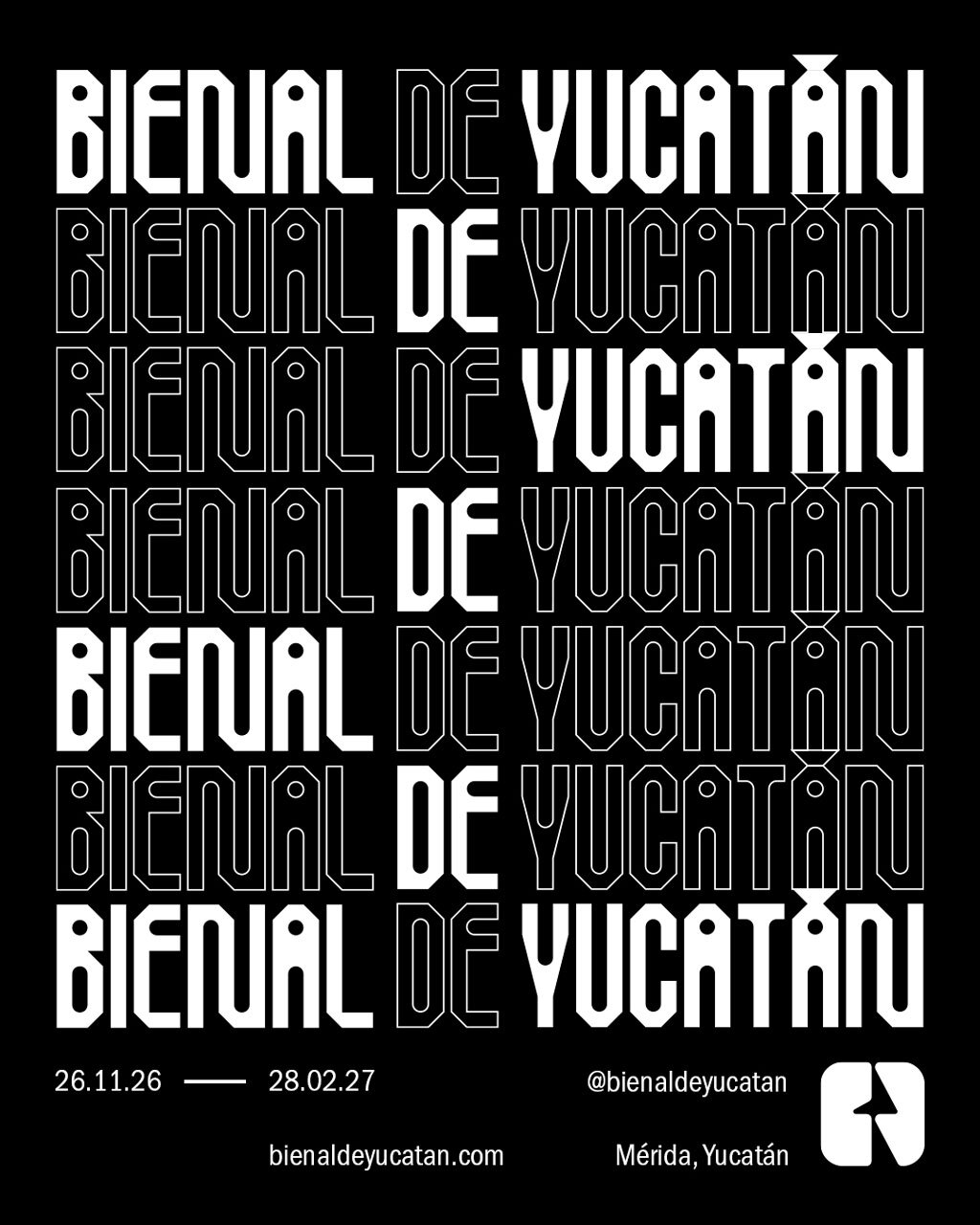
From Novemer 26, 2026 to February 28, 2027
IG: bienaldeyucatan
First published in Yucatán Today website in May 2026.


Related articles


