


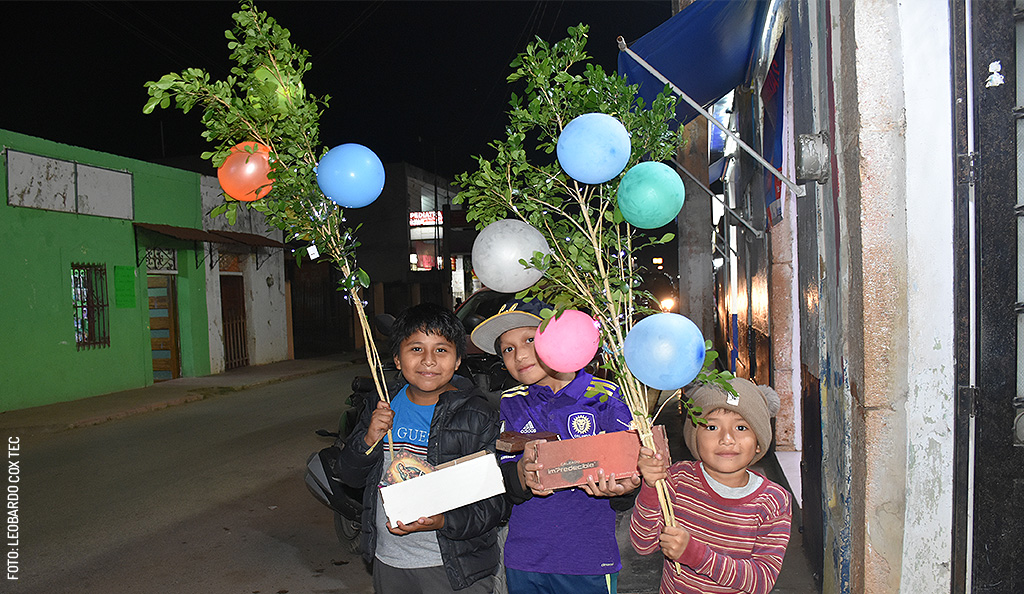
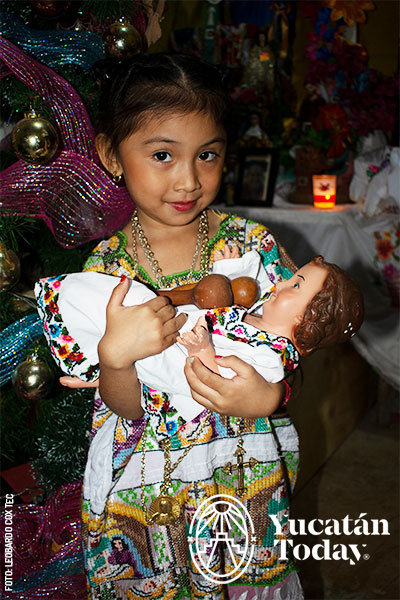
 La rama or ramada (The Branch) is a December tradition carried out throughout the Yucatán Peninsula and in other states in southeastern México, such as Veracruz and Tabasco. It is led by children who organize to decorate a small, makeshift portable altar.
This altar is constructed using a cardboard box and a branch from a limonaria (Murraya paniculata) or ch’íit palm (Thrinax radiata), decorated with balloons, paper chains (cadenetas), and cola de gato (cat tail), a popular local ornament. A religious image, such as the Virgin of Guadalupe or the Virgin of Izamal, is placed in the center of the altar. The final touch is the lighting, which might be a candle or a homemade farolito (lantern), often crafted from an aluminum can. This lantern is also used on December 8th, the Day of the Immaculate Conception, to light the entrance of the house.
The decorated branch emulates a small Christmas tree. With it, the children travel the streets of the villages, offering their songs from house to house in exchange for an “aguinaldo”—a Christmas bonus—which can be fruit, a treat, or money. Some carry maracas, tambourines, or claves to accompany and enliven the carols. The collected aguinaldo is divided among all participants, usually to buy more sweets or toys.
The Origin and History of La Rama
It has often been claimed that this tradition was brought by Franciscan friars upon their arrival in Maya lands. However, there is no documentary evidence to confirm this. Furthermore, the ancient Maya peoples during the Viceroyalty did not typically celebrate Christmas, precisely because December 25th was one of the important days for them to pay tribute to the encomenderos (Spanish colonists). The only ones who celebrated were the conquistadors.
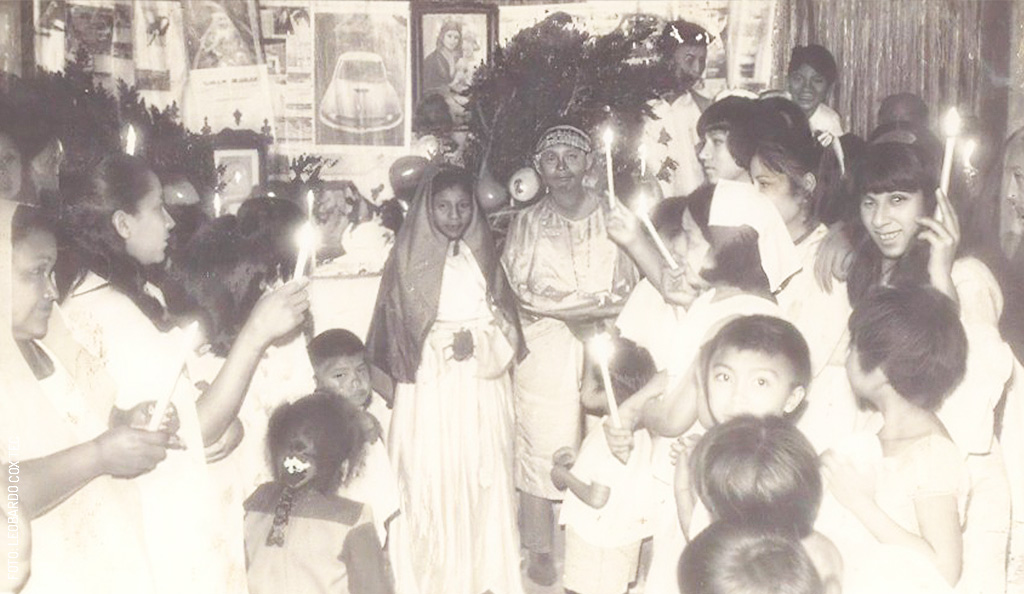 Mentions of the first Christmas trees in the city of Mérida appear in early 20th-century press, where it is recounted that children from affluent classes used to decorate fir branches. It is probable that the rama tradition originated in the cities and was later incorporated into Maya villages as a children's Christmas custom to teach the young ones the religious significance of the holidays.
The branches go out to offer their carols between December 1st and 16th, when the posadas (traditional nightly processions) begin. Photographs from the mid-20th century show that decorated branches were also used during the posadas, the main difference being size: the children's branch was small, and the one used in the posadas was much larger.
The Evolution of the Carol
Currently, there is an "official" song for the ramadas, with popular lyrics that all Yucatecan children know. A few years ago, it was common in the villages to improvise verses mentioning the names of local figures, important events, or the towns' patron saints, especially the Three Wise Men (Santos Reyes Magos). The longer the rama song, the larger the aguinaldo received.
Throughout the years, I have collected some verses in the eastern villages near Valladolid:
|
Ya llegó la rama, ya llegó de Cuba, y le trajo al niño su racimo de uvas.
Allá en el cielo mataron cochino, lo supo San Pedro y llamó a don Chino.
Déme mi aguinaldo con mucho cariño, como se lo dieron los Reyes al Niño.
Un recibimiento los Santos le hicieron, coronas brillantes al Rey le ofrecieron.
Los Reyes al Niño le dieron regalos y usted señorita, me da mi aguinaldo
Lindas azucenas, lindos girasoles, al niño Jesús traemos honores.
Deme mi aguinaldo, si me lo ha de dar, la noche es muy corta y tenemos que andar.
Ya se va la rama por la obscuridad Deseándoles a todos. ¡Feliz Navidad! |
The branch has arrived now, it arrived from Cuba, and it brought the Child a cluster of grapes.
Up there in heaven they slaughtered a pig, Saint Peter found out about it and called Mr. Chino.
Give me a Christmas gift with much affection, just as the Wise Men gave theirs to the Child.
A welcoming reception the Saints gave Him, shining crowns they offered to the King.
The Kings gave the Child gifts and you, Miss, you give me my bonus.
Beautiful lilies, beautiful sunflowers, to the Child Jesus we bring honors.
Give me my bonus, if you are going to give it, the night is very short and we have to keep walking.
The branch is leaving now through the darkness. Wishing everyone a Merry Christmas! |
First published in Yucatán Today website in December 2025.
Read about another version of the Rama in Yucatan



Related articles


