


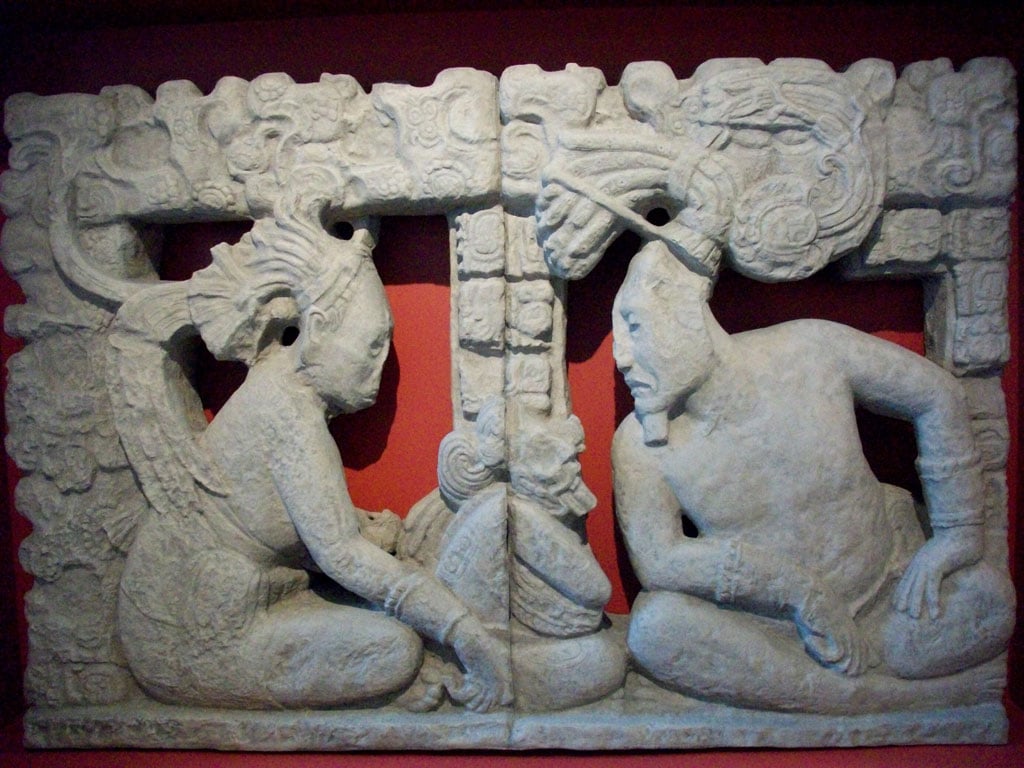
Ixchel is the Maya goddess of medicine, childbirth, water, and weaving, historically depicted as an elder midwife. Despite modern interpretations portraying her as a young moon deity, colonial records and Maya codices confirm her fundamental role as the patron of gestation and consort of the creator god Itzamná.
Maya Mythology: The Many Faces of Goddess Ixchel
When discussing one of the most important entities in the Maya pantheon, we should begin with a reminder: everything we know today about the pre-Hispanic Maya gods has gone through a long process of interpretation. To figure them out, experts have relied on two main types of sources: what are considered Maya "writings" (stelae, codices, and other inscriptions on monuments or artifacts) and the accounts and chronicles written after the arrival of the Spaniards, which we can assume have been, at least to a degree, shaped by the worldview they brought with them. On top of that, what we’ve discovered from Maya "writings" is due to constant breakthroughs in deciphering the few examples remaining, through research that only really began to make significant progress in 1952. After 400 years of mystery, reading Maya texts is still far from being an exact science.

That is why we find so many different interpretations of the popular Maya goddess Ixchel: that she is the wife of Itzamná (lord of the heavens and the most widely worshipped god in practice) or of Hunab-Ku (the primary deity, creator of all things); that she is the goddess of love, pregnancy, water, weaving, medicine, the moon, and fertility; that she is depicted as either a young woman or as an elderly woman pouring water from a jar; or that she is a dual goddess with various manifestations (a common feature in pre-Hispanic mythologies, where a deity can sometimes appear as another version of themselves). Among other variations.
Let us help you with the pronunciation of the Maya gods’ names:
Ixchel: eesh-CHELLE (ch as in chair)
Itzamná: eat-sam-NAH
Hunab-Ku: who-nab-KOO
Ixchel, Maya goddess of... the moon?
Today, the most popular image of this goddess is as the moon deity—the counterpart to the sun god. She is pictured as a young, fertile woman dedicated to medicine, representing a feminine power in direct connection with nature and motherhood. During the 20th century, this depiction elevated her to the high level of prominence she holds today, towering above many other female deities.

However, recent studies suggest that this broad collection of attributes may stem in part from a mistaken blend of several distinct goddesses, as well as a modern reinvention designed to shape a deity more "fitting" to the mindset of the era in which it is being studied (in this case, the 20th century). Unfortunately, this is a common occurrence in archaeology, even among well-intentioned specialists.
Furthermore, the earliest references connecting her to the moon appeared in the 1930s without any concrete backing from the sources available at the time. Instead, they drew on a very broad set of attributes that we now know belonged to different individual goddesses. It is worth noting that archaeology at the time leaned heavily on mythological frameworks centered around dualities, where lunar and nocturnal elements were almost always linked to women. This reflects an old European archetype of lunar femininity—a subtle mysticism that undoubtedly survives to this day.
Ixchel, Maya goddess of... pregnancy?
What we do know about goddess Ixchel from the Maya codices in which she appears (such as the Dresden and Madrid codices), as well as early Spanish texts from the Península, links her to an older woman: the wife of Itzamná and goddess of water, pregnancy, and weaving.
Her primary place of worship was located in the Caribbean, on what is today the island of Cozumel. Although surviving archaeological remains there do not fully reflect her former scale, chronicles from the Conquest era document women making pilgrimages from various parts of the Península to visit her shrine.

In this light, her depiction as a young woman may stem from our tendency to associate fertility with youth. In reality, Ixchel’s role was likely that of an elderly midwife guiding women safely through pregnancy and childbirth—a concept far more aligned with a goddess of medicine.
In the end, we must remember that many things can be true at once. While some pre-Hispanic deities may have had multiple manifestations, that shouldn't stop us from re-evaluating how we view the past. And, of course, we can do so while continuing to appreciate and marvel at everything Maya culture represented in its time and all that has endured to this day.
First published in Yucatán Today print and digital magazine no. 468, in December 2026.


Related articles


