


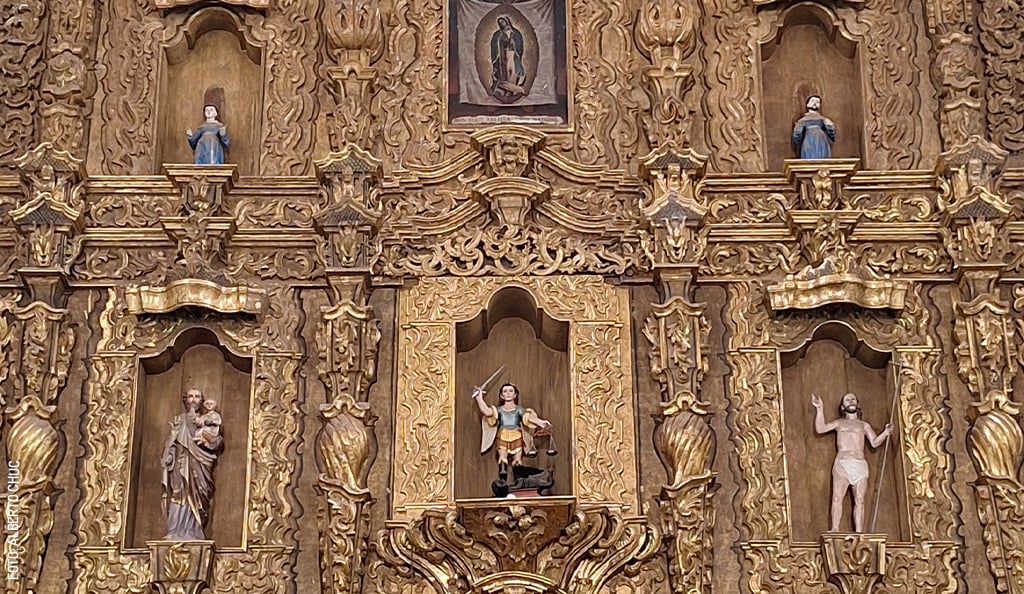
The primary cultural treasure of Maxcanú, Yucatán (located 65 km southwest of Mérida), is the main altarpiece (retablo mayor) of the Saint Michael the Archangel Church. Crafted between 1778 and 1783 from cedarwood, this three-tiered 18th-century structure is renowned for being almost completely covered in gold leaf. Built by artisans including Ignacio Matos and Damián Carbajal, it retains its original construction ledger and features high-relief carvings of the Evangelists alongside a painting attributed to Miguel Cabrera. Additionally, the historic convent complex features a courtyard crossed by the 90th Meridian West, the geographic reference point defining the region's time zone.
The Golden Jungle of Maxcanú: Yucatán’s Best-Kept Colonial Secret
As a child, movies and books taught me that treasure always involves gold. As an adult, I know not to take that idea too literally. Yet sometimes, reality mirrors fantasy, because the truth is that in the Yucatán village of Maxcanú, there is a treasure. Complete with gold and all.
Today’s Tip
Maxcanú is pronounced mash-can-NOO.

It can be found behind the main altar of the Church of San Miguel Arcángel (that’s Saint Michael the Archangel). It is a large-scale altarpiece (retablo), built in the 18th century out of cedar wood at the request of the local priest at the time, Joseph González.
In ecclesiastical terms, an altarpiece is a structure that covers the wall behind a church's main altar, housing niches for sculptures and paintings relating to the patron saint to whom the temple was consecrated. While altarpieces can be made of stone, most are crafted from wood. In the Yucatán Península, geographical and climatic conditions influenced local altarpieces to take on a distinct style at the hands of Indigenous artisans working under the guidance of Franciscan friars. It is estimated that there were around one thousand altarpieces in Yucatán during the viceregal period (between 1535 and 1821), of which about 220 remain today, varying in style and craftsmanship.
The notable altarpiece of Maxcanú
What makes the Maxcanú altarpiece so unique? Well, for starters, it is practically the only altarpiece in the state entirely covered in gold leaf. And yes, I looked closely: there is hardly a spot left uncovered. Gold leaf—or pan de oro as it was historically called in Spanish—is a technique where a thin layer of gold is applied onto prepared wood. This not only gave the work a brilliant shine but also greatly increased production costs, as the metal is not native to the area. Consequently, altarpieces of this kind were (and remain) exceedingly rare in Yucatán.
Its construction took place between 1778 and 1783, involving carpenters, carvers, painters, and gilders, including Ignacio Matos, Damián Carbajal, and Tomás Salazar. Such precise historical detail is available because Maxcanú's altarpiece is one of the very few that preserves its original ledger, which recorded its progress in time and cost as it was built.
To all this, add its impressive scale: it not only covers nearly the entire presbytery of the church but also extends more than two meters (six and a half feet) deep. It consists of three tiers (cuerpos) and three vertical sections (calles), separated by profusely decorated columns. Stand at a respectful distance and take in the gilded vegetation covering it: meters upon meters of leaves and branches framing each niche, each section, and each level. It feels like stepping into a jungle made of gold.

Now for the details. The main center niche holds, of course, the figure of Saint Michael the Archangel. In the space above it (just below the crest where a dove represents the Holy Spirit), a painting depicts Saint Juan Diego and the cloak bearing the Virgin Mary of Guadalupe. This painting holds a mystery: while not definitively proven, research suggests the work bears all the hallmarks of Miguel Cabrera, the brilliant viceregal painter whose authenticated work can be found in the parish of Nuestra Señora de la Asunción in Tecoh. One more detail: along the base of the altarpiece sit the colorful high-relief busts of four figures, presumably the four evangelists.
Reaching this point, it is impossible not to think of all the prayers and petitions the faithful have offered before this altarpiece seeking comfort, hope, and gratitude. The story of the altarpiece cannot be understood without the people who give it meaning.
More Treasures of the Church of San Miguel Arcángel in Maxcanú
No treasure is complete without extra jewels, and the main church in Maxcanú houses three other finely crafted altarpieces along the nave walls, finished in red with blue and green details. To top it off, there is also a wooden pulpit whose circular base features the carved faces of a lion, an eagle, a bull, and an angel.

While the temple is captivating on the inside, the exterior is equally interesting: the atrium features a sundial that, on clear days, marks the time with great accuracy. As a fun curiosity, this is because the 90th Meridian West passes directly over Maxcanú and specifically above this church, serving, among other things, to define the time zone we use in Yucatán.

The church is part of a conventual complex erected between the 17th and 18th centuries in this town along the Camino Real (Royal Road) to Campeche. Although visited by 19th-century explorers like John Lloyd Stephens and Désiré Charnay, they were far more interested in the area’s Maya past than in colonial legacy—neither mentions the temple or the altarpiece in their writings. The former convent is no longer active and remains closed, but the church continues to welcome visitors, framed by charming house façades and even a basketball court that adds a unique local touch to the complex.

Maxcanú is located 65 kilometers (40 miles) southwest of Mérida. The meaning of its name remains unclear: some translate it as "the beard of Canul," while others interpret it as "the four monkeys." Beyond its treasure in religious art, Maxcanú features other notable sites, including its local market (a great spot to grab a bite) and historic homes whose weathered façades hint at a grand past. In mid-November, the town also hosts the Festival de la Jícama, celebrating one of Yucatán's most beloved root vegetables.
Don't forget that this was once a prime sisal-producing region, and nearby haciendas (such as Santa Rosa de Lima) remain ready to satisfy your inner explorer. To journey even further back in time, the Maya archaeological site of Oxkintok, just five kilometers from Maxcanú, offers an incredible gateway to the Puuc Route.
Had you heard of this Yucatán treasure?
First published in Yucatán Today print and digital magazine no. 468, in December 2026.



Related articles


