


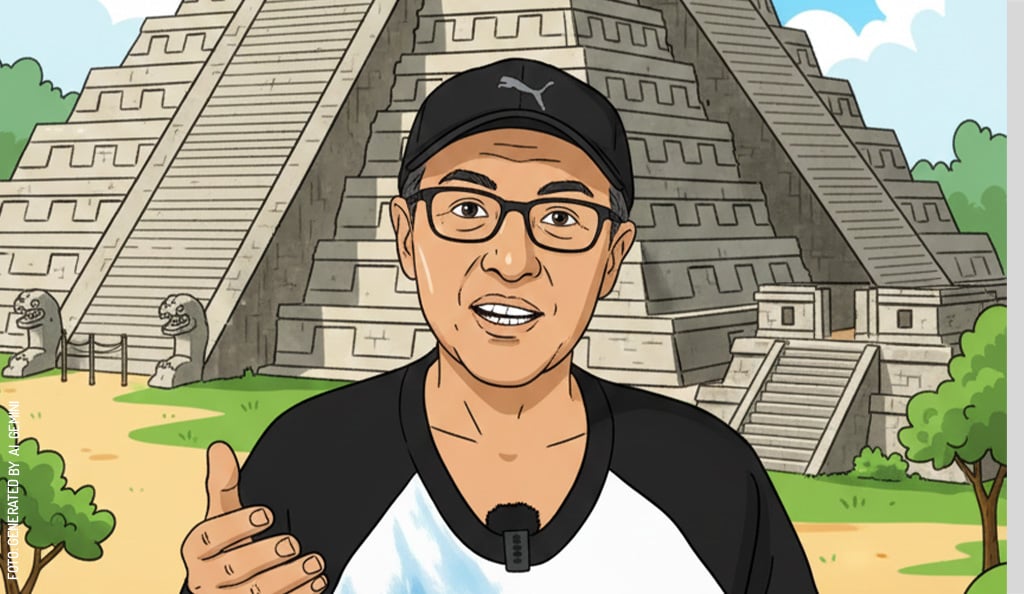
My name is Alberto Chuc, and I have a story to tell you. It turns out that I’ve been asked how to spell my last name so many times that I often have to spell it out: C, H, U, C.
—"With a K at the end?" they insist. —"No," I reply, "just the C."
As a child, having a name like this felt normal, though other than my relatives, I didn’t (and still don’t) know many other people named Chuc. While it is relatively common in the Península, it’s not as widespread as one might think. Outside of Yucatán, its rarity is even more apparent.
From Alberto to “Chuc Norris”
During the years I lived in México City, something curious happened: I stopped being Alberto and simply became Chuc. My last name replaced my first name and became my nickname, often with variations like "Chuc Norris," which some found hilarious due to the action movie star reference.
However, the curiosity to learn more about my roots didn’t hit me until adulthood. I checked Maya-Spanish dictionaries, spoke with my father and aunts, and searched through historical records. While names like Canek, Cituk, or Pat have documented historical weight, many other Maya surnames, including mine, are barely mentioned. The origin of our family names is lost in the mists of time. Did they emerge from the ancient provinces of Cochua, Chakán, or Ekab? We may never know for sure.
What’s in a (Maya) name
Regarding its meaning, most sources agree that the word chuc means "charcoal" or "ember." As it happens, it seems that in ancient times people’s names were based on references to a place (such as Aké, the place where vines grow), an animal (such as balam, the jaguar), or the family’s main activity. That means that it is likely that the first people to carry the name Chuc were charcoal makers.
However, depending on the spelling—since in the Maya language there are variations like chúuk, chuuk, ch’úuk, and ch’uuk—it can also mean to catch, to reach, or to obtain. I must admit I particularly like the aspirational tone of those last two meanings.
I love the way my last name sounds. Like other Maya surnames that are widespread in Yucatán, it is short and punchy. It fits perfectly on the spine of a book, or in any space, as little as it may be. In terms of looks, the four letters that comprise it make for an eye-catching logo or brand name.
Above it all, it has flavor. There’s poc chuc, that charcoal-grilled pork delicacy served with smooth strained beans, chiltomate, pickled red onion, and tortillas (handmade, preferably). This dish has made the Magical Town of Maní one of its capitals, even though it’s prepared in many other places as well.
And, of course, the delicious and healthy habit of “hacer chuc”: the act of dunking bread into chocolate or coffee—a tradition said to have started in the old henequén haciendas, when workers would dunk their bread in jícaras filled with hot chocolate at supper.
Pride or prejudice
Along the way, I also learned some bitter truths. I discovered that for some, carrying a Maya surname was (and still is) a reason for shame or mockery, or a sign of inferiority. But why feel shame about one's origins?
Outside of México, the opposite happens. When people learn my last name is Chuc and that it is Maya in origin, they become interested in the history of Yucatán and ask if I speak the language. I try to answer as well as I can, and I admit with some regret that I do not speak Maya, other than the words that have been incorporated into Yucatecan Spanish. Still, people’s curiosity and interest in my last name make me feel proud.
Hello, my name is Alberto Chuc. What is your name?
First published in Yucatán Today print and digital magazine no. 459, in marzo 2026.



Related articles


