

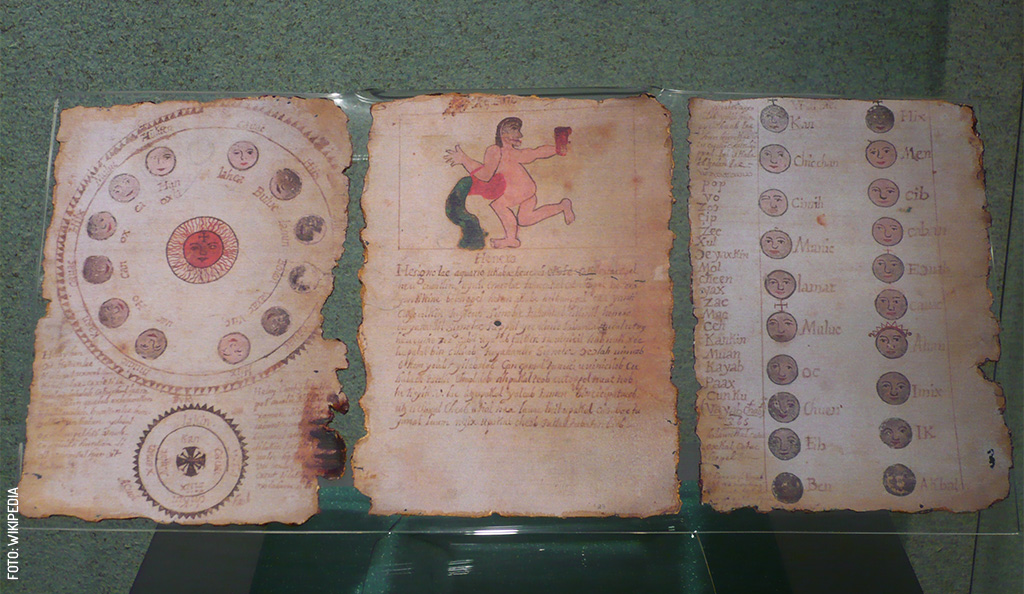
During your exploration of the Maya lands, you might come across the words Chilam Balam. Alongside the Popol Vuh (or, as it is now called by K’iche’ speakers, the Popol Wuj), the Chilam Balam is considered one of the most important works of traditional Maya literature. But if you look for it in a bookstore or library, you'll quickly notice something curious: there isn't just one Chilam Balam. Instead, you'll find titles such as The Chilam Balam of Chumayel or The Books of Chilam Balam. Why the difference?
The name Chilam Balam does not refer to a single text, but rather to a collection of manuscripts produced in different Maya communities of Yucatán during the colonial period. Although they were written in the Yucatec Maya language, they use the Latin alphabet introduced by the Spanish. Some scholars have even suggested that these manuscripts emerged, at least in part, from efforts encouraged by the colonial religious authorities to preserve aspects of Maya culture after many of the original hieroglyphic codices had been destroyed.
Hence the origin of those important and most curious manuscripts known as the Books of Chilam Balam, written in the Maya language using the Christian alphabet by more or less educated Indians [...] who transferred into Christian writing what had formerly been contained in hieroglyphs and ancient phonetic signs on painted books or skins [...] these books being passed down from parents to children, with successive copies being made.
Crescencio Carrillo Ancona, 1881
The nine surviving Chilam Balam manuscripts
Today, nine Books of Chilam Balam are known to survive. The manuscript from Chumayel is by far the most complete and the one most frequently translated into languages beyond Spanish. The others are named after the communities where they originated: Kaua, Ixil, Maní, Nah (present-day Teabo), Tekax, Tizimín, Tusik (now Temozón), and Yaxkukul.
Unlike the Popol Wuj—which belongs to the K'iche' Maya tradition rather than the Yucatec Maya—these books are far more than collections of myths or historical narratives.
Their purpose was to preserve as much Maya knowledge and tradition as possible, including beliefs that predated the Spanish conquest, even though many had already been influenced by Catholicism and European cultural perspectives. As a result, the manuscripts cover an astonishing range of subjects: religion, indigenous traditions, history, the Maya calendar, medicine, astrology, astronomy, prophecies, rituals, literature, and many others that resist easy classification.
So, what does Chilam Balam mean?
Because so much about the manuscripts' origins remains uncertain, scholars can only offer educated interpretations. Even the title itself has no universally accepted translation.
Today, balam is commonly understood to mean "jaguar," but the word can also refer to a sorcerer or magician. Likewise, chilam may mean "mouth" or "he who is the mouth"—a title often associated with Maya priests or prophets who served as spokesmen for the gods. Depending on how the words are interpreted, the title has been translated in various ways, including Mouth of the Sorcerer, Mouth of the Jaguar God, or Jaguar Priest.
The surviving manuscripts themselves were written by anonymous authors, most likely between the sixteenth and nineteenth centuries. Such a broad time span suggests they may have been collaborative works, revised and expanded by successive generations.
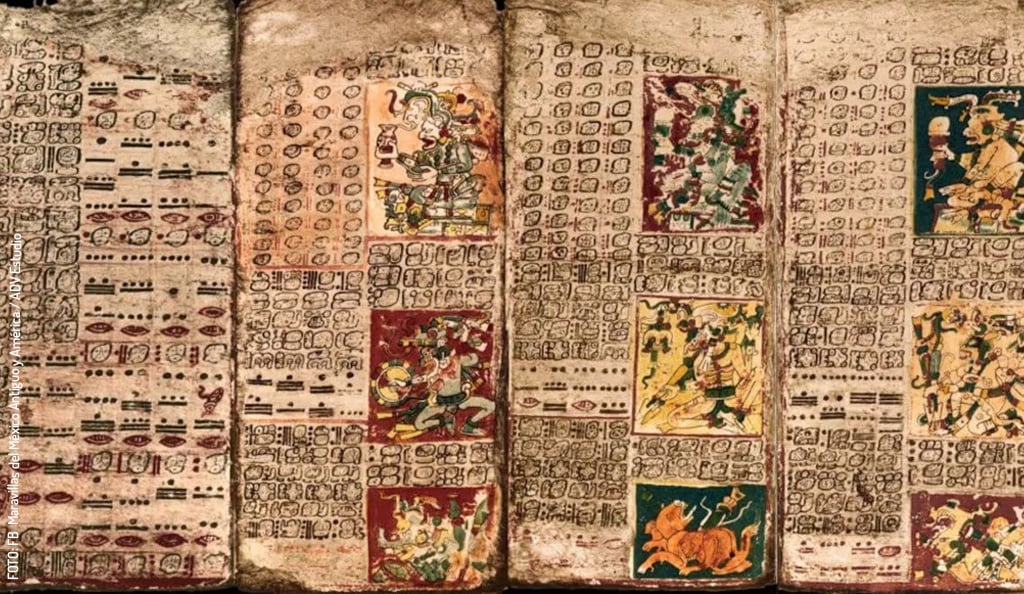
No one knows how many Books of Chilam Balam originally existed. Others may have been written before the conquest in the form of hieroglyphic codices and later destroyed during the colonial campaigns that consigned countless Maya books to the flames. It is equally possible that the surviving manuscripts were part of a broader movement to recover and preserve Maya knowledge after that loss, using the writing system introduced by the Spanish while continuing to record a distinctly Maya worldview.
Whatever their origins, it seems likely that many more once existed, even if only these nine have survived.
.jpg)
Reading the Books of Chilam Balam
The Books of Chilam Balam are difficult to categorize. Some scholars even consider them a literary genre of their own. They are compilations of remarkably diverse texts, moving from historical accounts to herbal remedies, prophecies to religious commentary, often without any obvious organizational structure.
That can make them somewhat disorienting for modern readers. Yet these manuscripts played an invaluable role in preserving knowledge of Maya civilization at a time when scholars had not yet deciphered the hieroglyphic inscriptions carved on stelae and monuments.
Despite the unmistakable influence of Christianity and Spanish colonial culture, the Books of Chilam Balam remain powerful testimonies to the resilience of a people determined to preserve their traditions in the face of profound cultural change.
First published in Yucatán Today print and digital magazine no. 465, in September 2026.


Related articles


