


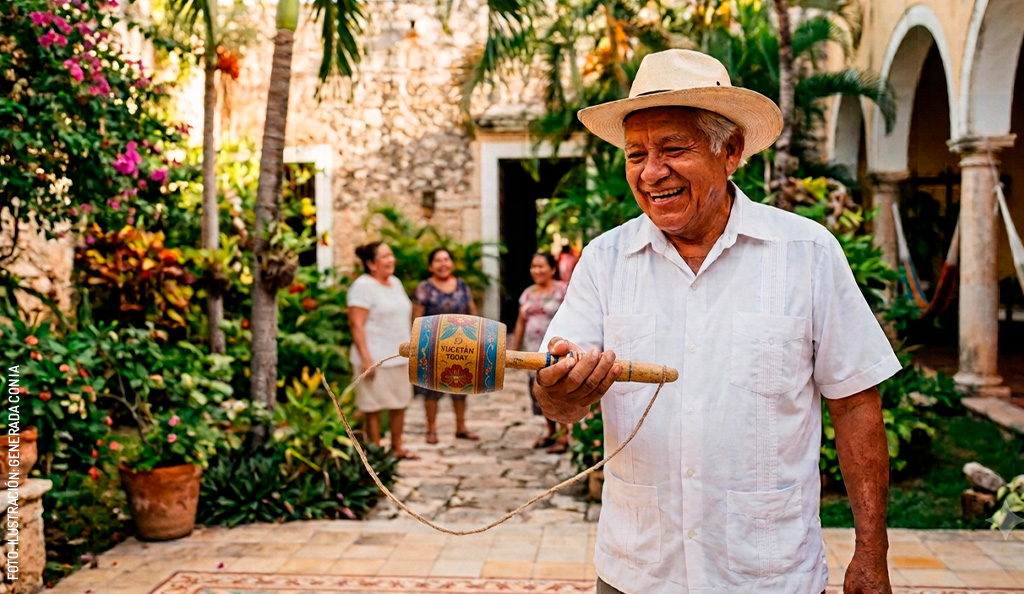
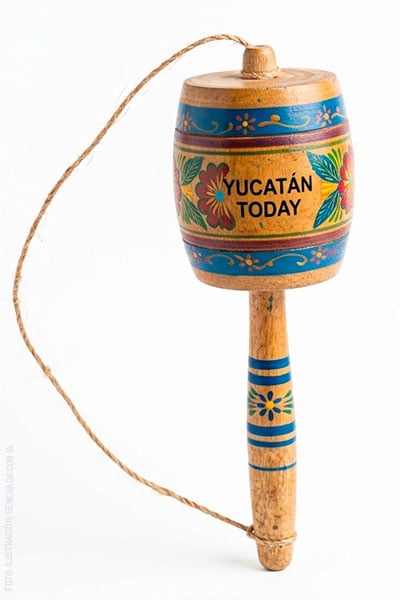
I went and got myself a balero. You might be familiar with a similar version: the cup-and-ball or bilboquet. The balero is a toy that consists of a wooden stick attached by a string to a drum-shaped piece of solid wood that has a hole in the bottom. Mine is made of wood and has a simple finish—just a coat of varnish—but you can also find beautifully hand-painted versions decorated with colorful designs.
I paid $70 pesos for mine, although, depending on the size and where you buy it, they can cost well over 200. You can find baleros just about anywhere in México: markets, craft shops, souvenir stores, or—in my case—a small-town hardware store, which says a lot about just how deeply rooted they are in everyday life.
Why did I buy one? Let me explain.
Like many kids who grew up in Yucatán before video games and social media took over, I spent my childhood playing with traditional toys: spinning tops, yo-yos, marbles, and kimbombas. Out of all of them, though, the balero is the one that still refuses to cooperate. I've never managed to land the drum on the stick—not even once. That’s the point of the balero: with a quick flick of your forearm and wrist, you're supposed to launch the wooden drum into the air so that, as it falls, it lands perfectly on the peg.
Simple, right? Not even close.
The balero looks deceptively easy, but mastering it is another story entirely. The thing is, I simply can't go through life knowing I've never successfully caught a balero—not even once.
The Origins of the Balero
There's much more to the balero than meets the eye.
For starters, it doesn't have a single place of origin. Versions of this toy have appeared throughout history in different parts of the world, from Asia to Europe. There is even evidence suggesting that the ancient Maya had their own version, which, according to some interpretations of Classic-period artwork (ca. 250–900 CE), may have used a human skull instead of a wooden cup. If that's true, however, it was probably more ceremonial than recreational.
France has its own version, known as the bilboquet, which has been documented since the sixteenth century.
Even the name changes depending on where you are. In Mexico and Argentina it's called balero; in parts of Central America, capirucho; in Spain, boliche; in Chile, emboque; in Venezuela, perinola; while Japan's famous version is known as the kendama.
As harmless as it looks, the balero deserves a little respect. A poorly timed attempt can leave you with a pinched finger or a smack on the hand or forearm. Trust me—I know.
What it definitely does provide is an excellent workout for your hand-eye coordination. Every movement has to line up perfectly: the swing of your arm, the snap of your wrist, and just the right amount of force so the drum rises high enough, stays balanced, and drops neatly onto the peg.
Toy... and Folk Art
The balero may be a toy, but over time it has also become a piece of folk art. Today it's sold in craft shops throughout México, and a collection of baleros is even part of the permanent collection at the Museum of Popular Art in Mexico City, just a short walk from Alameda Central.
The one I bought is made from hardwood. According to the shopkeeper, it's cedar, although many are also carved from pine. Craftspeople begin with carefully selected blocks of wood, which are shaped on a lathe into the two pieces of the toy. They are then sanded, varnished, painted, and decorated before finally being joined by a cord of precisely the right length—long enough to wrap exactly once around the drum, not a millimeter more or less.
In México—and certainly here in Yucatán—the balero is much more than a game. It's a tradition that celebrates both the craftsmanship required to make it and the skill needed to master it. It also reminds us of a time when entertainment didn't involve staring at a screen.
How long has it been played in Mexico? A titipuchal of years—a whole lot. Like I said, the Maya might have played it. So it may not come as a surprise that the Guinness World Record for the most consecutive catches belongs to a Yucateco: in 2015, Pedro Pablo Zapata successfully landed the balero 1,058 times in a row.
My ambitions are considerably more modest: I just want to do it once. One simple catch would make me happy. After all, that's only the beginner's trick. There are more advanced moves too, including the double catch, where the cup spins twice in the air before landing on the peg.
That's a move for the masters.
As I write these lines, I still haven't managed it. I've come close, and I've already smacked myself a couple of times. But I'm still practicing. Maybe by the time you're reading this, I'll finally have landed my first catch. Wish me luck.
First published in Yucatán Today website in July 2026.


Related articles


