


The Xtakay: Yucatán’s Most Famous Yellow Flycatcher
There are more than 500 bird species that call Yucatán home, whether temporarily or permanently. Today, we’ll talk about a group that shares a Maya name due to their strikingly similar physical characteristics.
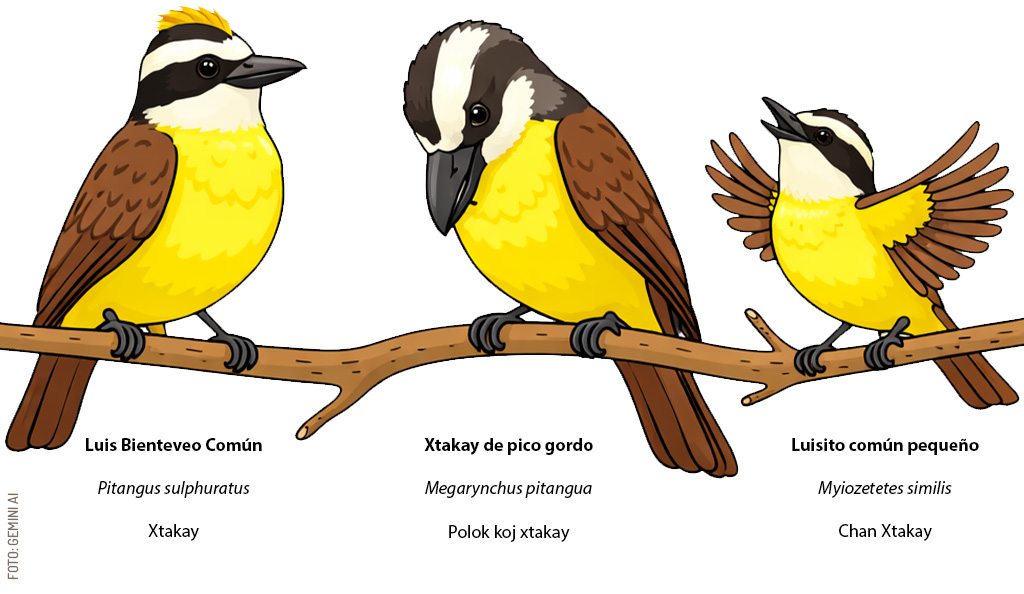
- Pitangus sulphuratus (in English, great kiskadee) is the xtakay (pronounced shh-tack-AYE).
- Megarynchus pitangua (boat-billed flycatcher) is the polok koj ktakay (pronounced pole-OCK koh shh-tack-AYE), Maya for "thick-billed xtakay."
- Myiozetetes similis (social flycatcher) is the chan xtakay, or "little xtakay."
Why are so many species called xtakay?
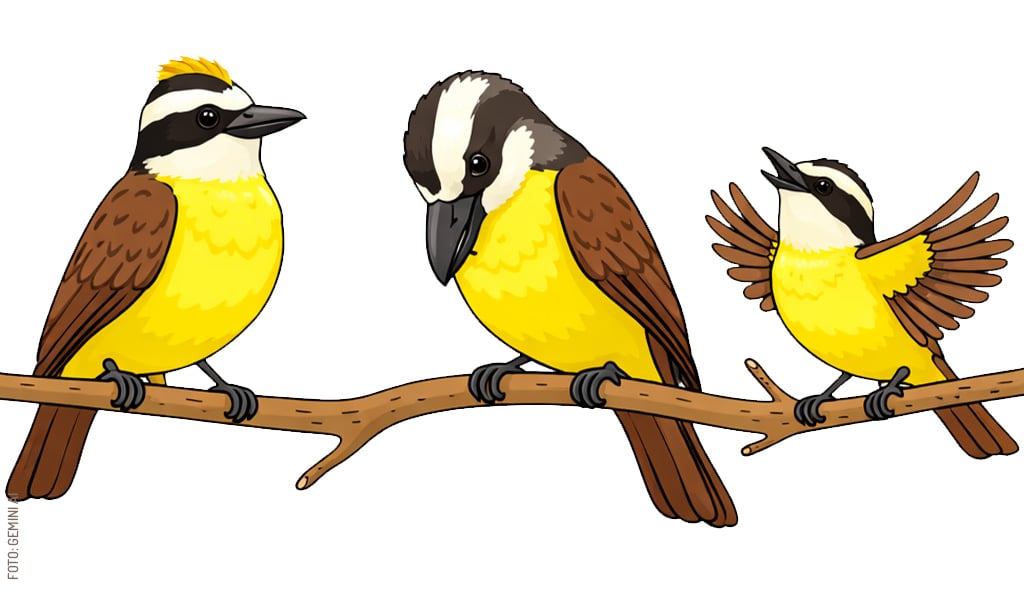
All three species are common throughout the state of Yucatán and are relatively easy to spot year-round, even within the urban areas of Mérida. Despite belonging to different genera, these three birds are physically very similar: they all sport brown wings, bright yellow bellies, and white heads with a distinctive black "mask" and beak.
How do they differ? Beyond slight tonal variations, the standard xtakay (Great Kiskadee) has a yellow "crown" or crest that, while hidden most of the time, is very noticeable when deployed. Both the xtakay and its "thick-billed" cousin have strong, long beaks with downward-curved tips, while the chan xtakay has a thinner, shorter, and straighter beak.
What do xtakayes eat?
These three species share a diet based on insects and fruits. The smallest of the three also adds seeds to its menu, while the larger xtakay is known to hunt small fish, lizards, snakes, and even small mammals, like rodents.
When and where to see xtakayes in Yucatán?
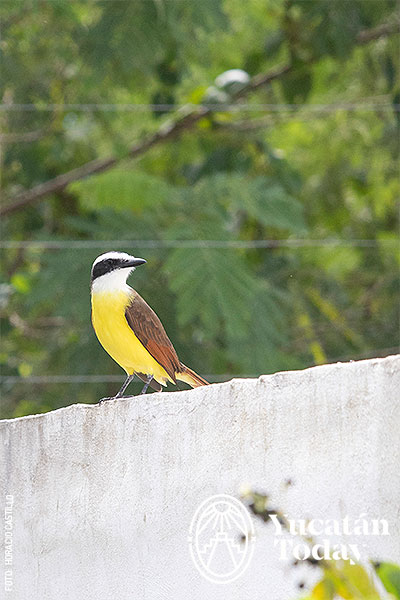 All three species are permanent residents of Yucatán, and fairly easy to spot, even in Mérida. Great kiskadees prefer more open, less wooded areas, while their boat-billed counterparts tend to perch in the shelter of a canopy. The chan xtakay, being a more social species, is often spotted in pairs or groups, especially in semi-open areas.
If you pay attention to your surroundings, you are pretty much guaranteed to spot at least one variety of xtakay (most likely a great kiskadee or a social flycatcher) on a utility pole, power line, or even a garden wall.
The sound of the xtakay: legend and language
While the chan xtakay is said to be the most common of the three, the great kiskadee xtakay is the one that never goes unnoticed, thanks to its powerful and distinctive call. In many languages, its name is an onomatopoeia of its song: in English, it’s “Kiskadee”; in Portuguese, “Bem-te-vi”; and in Spanish, depending on the region, it is “Cristo-fue” or “Bien-te-veo”.
In Maya, its song is interpreted as “tuuskepech,” which translates to “you are lying” or “you are joking.” Because of this, local tradition says that if someone is discussing plans or making a promise and an xtakay calls out, those plans might not come true.
Listen to the calls:
- Great Kiskadee (Pitangus sulphuratus): Listen here. Notice if you can distinguish the "tuuskepech" sound, or if it sounds more like "kiskadee" or "bien-te-veo." Regardless, there’s no doubt the xtakay sings as if it were shouting.
- Boat-billed Flycatcher (Megarynchus pitangua): Listen here. You’ll find this one less intense, with some warbling.
- Social Flycatcher (Myiozetetes similis): Listen here. This call is more like a squeak—higher-pitched and shorter.
You can find out more about the different types of xtakayes and other Yucatecan species in the book Guía de Aves Xocén: Centro del Mundo, published by the Centro de Investigación Científica de Yucatán in 2022.
Sources
Dorantes Euan, A., Tello López, I. A., y Castillo Cimé, Á. F.
(2022). Guía de aves, Xocén: el centro del mundo. Centro de Investigación Científica de Yucatán.
First published in Yucatán Today print and digital magazine no. 461, in May 2026.



Related articles


