


For many, many years, talking about a "Yucatecan liqueur" meant talking about only one thing: xtabentún. This delicious liqueur does taste like mestizaje (cultural blending)—the honey of the Maya combined with the anise brought by the Spanish. Recently, however, a new wave of creative spirits has emerged to delight all types of palates, featuring varying alcohol proofs, flavor profiles, aromas, and body.
Here’s a short list of some of the ones I’ve tried; I encourage you to try them and find a new local favorite.
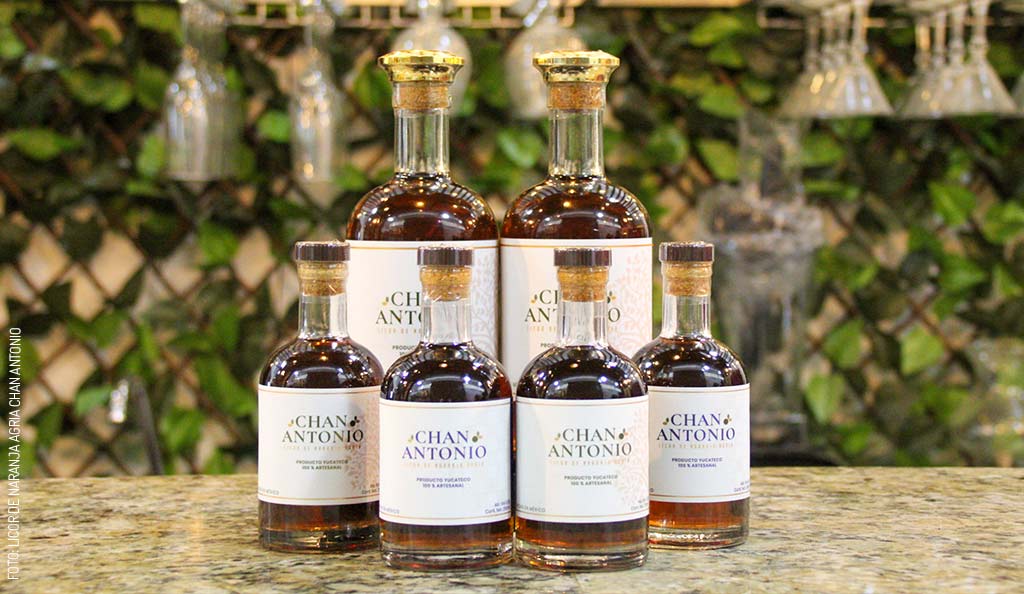
Chan Antonio Bitter Orange Liqueur
Bitter or sour orange (naranja agria) is an essential staple in traditional Yucatecan cuisine, excellent for marinating meats, making dressings, and even better when prepared as a refreshing drink. That’s why it seems almost unbelievable that the idea of making a bitter orange liqueur came up only as recently as 2017, from the mind of two university students.
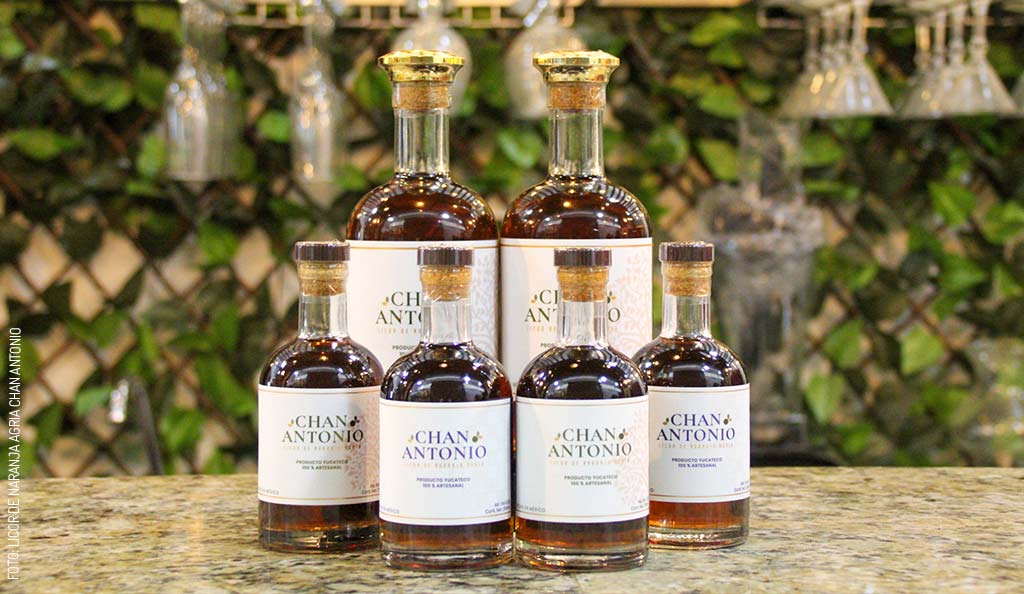
Today, their project is called Chan Antonio (in honor of the community where they source the oranges, Chan San Antonio, near Tizimín) and has grown from a home-brewed creation to producing 400 liters (over 100 gallons) per month, with plans for even more expansion.
I had the chance to try the Chan Antonio liqueur neat, and I found it fabulous as an aperitif or digestif. According to Christie Argáez, one of the founders, it's also found great success as a base in cocktails and mixology, and I completely understand why.
Want to try it? Besides selling directly, Christie and her sister, Cecilia, make it available for sale and tasting at various locations throughout the state, including Donia Way, Esencia Maya, Mexí Boutique, and Casa Catorce – U Yotoch in Mérida. If you prefer to sample it in a cocktail, several restaurants, including Picheta in Centro, feature delicious drinks that incorporate it.
Yatzil: Habanero Chile liqueur
Another key element in Yucatecan cooking is the habanero chile: prized for providing a unique flavor (not just heat) to dishes, it's also gentler on the stomach than, say, a jalapeño.
Yatzil (meaning "something beloved" in Maya) is another example of young Yucatecan creativity and is also a sister-run endeavor. Linda and Nancy Hernández are the minds behind this habanero chile liqueur, the result of a citrus and herbal maceration process with a lingering spicy finish you have to experience for yourself. A key characteristic of such an aromatic liqueur is its versatility; it can elevate almost any flavor combination you pair it with, making it an outstanding choice for cooking, mixing with other drinks, or sipping straight.


Tip: If you're curious, the “La Quema” cocktail at Restaurante Teya Santa Lucía is an excellent way to sample it. You can also try some of their prepared drinks, locally marketed under the “Makech” brand.
IG: Licor Yatzil
FB: Yatzil Mx
Elohim Coffee Shop: Wines and Carajillos from Peto, Yucatán

Wait, a coffee shop? Weren't we talking about alcoholic beverages? Just hold on, it gets good. Elohim started as a coffee shop in Peto, in the southern part of the state. Following the pandemic, and due to popular demand, Eddier and Damari, the couple behind Elohim, began successfully crafting and distributing cold brew coffee.
But Elohim is here for a different reason. More recently, Eddier and Damari began making wine from bougainvillea flowers and hibiscus flowers (flor de jamaica). For me, it's simply impossible to decide which I liked better: both are incredibly fresh, delicious, and light, with a perfect balance of sweetness and acidity. Both are available in 355 ml and 700 ml bottles.
And finally, to close this chapter with a flourish, their most recent creation: the Yucatecan carajillo, made with their cold brew, Elohim coffee liqueur, and a very local spice blend. Ready to drink—you only need to chill it to enjoy a new Yucatecan classic, from Peto with love.
Elohim has stores in Peto and Tekax. In Mérida, you can find their products at Cofrappia, or you can buy directly from Eddier and Damari for delivery or pick-up.
Pickup Address: Calle 49-A #942 x 86 y 86-A, Real Montejo
Phone: 999 221 7522 and 997 139 7079
Lukum: Licor de Henequén
 Henequen (Agave fourcroydes) is the native agave of Yucatán. Historically, its fame and value came primarily from its fiber for making textiles and ropes. Being so valuable in that form (it was known as "green gold"), it may be obvious why Yucatán didn't "waste" it by creating spirits, as it happened in Jalisco with tequila or Oaxaca with mezcal.
However, the rise of synthetic fibers opened the door to exploring a new product: henequén liqueur. Kuuch is one of the pioneering companies in its creation, with the Lukum line, which appeals to any palate with its three varieties: joven (young), reposado (aged), and an infusion with coconut essence. Kuuch also crafts a delicious cane liqueur with tangerine and traditional Xtabentún.
You can find Kuuch liqueurs at Murciégalo Mezcalería and Posheria.
IG: kuuchdestilados
FB: Kuuch Destilados de Henequen
Gin Katún: A London Dry with the Flavor of the Peninsula

Gin is a spirit with a long European tradition. If you're a connoisseur, you know that gin, beyond the juniper berries that provide its core flavor, uses various botanicals that give it a unique taste and aroma.
With this in mind, a group of entrepreneurs decided to create a Yucatecan gin: thus, Katún was born. Its name refers to a Maya measure of time, and its body honors the land that gave it life: its 17 botanicals include achiote (annatto), chile xcatic (local yellow pepper), Yucatecan lime, china lima (sweet lime), and allspice, in addition to cardamom, cinnamon, and sage. All elements, except for the juniper berries, are Mexican, and most are Yucatecan. The result is a London Dry style gin that truly could not be made anywhere else. Despite its short life (founded in 2018), it has conquered palates across México and the world.
According to founder Roberto Brinkman, the perfect way to truly appreciate Katún and discover its flavors is in an Old Fashioned glass: 1.5 oz of Katún with a slice of the citrus of your choice. If you want to sample it first, you can find it at several Mérida restaurants, including Salón Gallos. To buy it, you can visit La Mediterránea or La Botillería (Calle 53 x 56, Centro).
IG: ginkatun
Yumbab: The Honey-Flavored Xtabentún
 While originally this piece was about liqueurs other than xtabentún, we can't ignore a version that truly sets itself apart: Yumbab.
Yumbab emerged in 2016 as an alternative to traditional xtabentún and its strong anise flavor (which is loved by many, but not at all by others). Before the Conquest, xtabentún was made exclusively from the honey of the xtabentún flower. When the Spanish arrived and brought anise with them, the drink transformed to incorporate this flavor and aroma familiar to the conquistadors.
Yumbab decides to take xtabentún a step closer to its original version: it includes a hint of anise, but it tastes primarily of honey, which is a purely Yucatecan product. Furthermore, the honey they have used since 2017 is certified organic honey, requiring special care for the bees raised in areas completely free of agrochemicals.
With just 19.5 percent alcohol by volume, Yumbab can be mixed, but co-founding partner Ana Karen Peniche believes there’s nothing like trying it on the rocks to savor it best. Want to try it? It is available at Arcano in Mérida, as well as at Kinich and La Casona de Izamal, both in the Pueblo Mágico of Izamal.
FB: Yumbab
First published in Yucatán Today print and digital magazine no. 421, in January 2023.
Updated and republished in Yucatán Today print and digital magazine no. 456, in December 2025.


Related articles


