


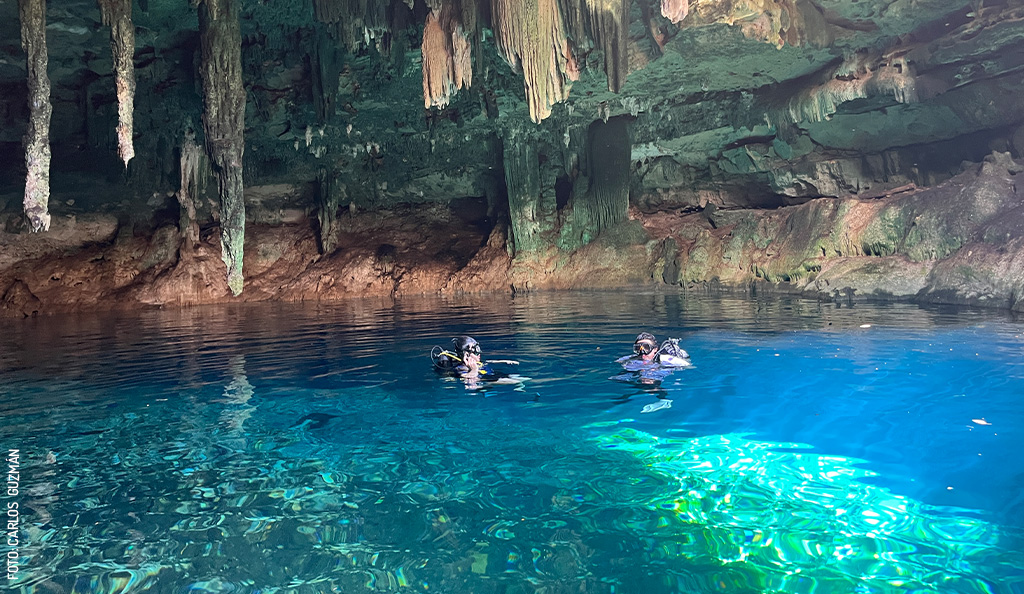
Cenotes have always been a major draw in Yucatán, attracting people from all over the world to immerse themselves in their crystal-clear, bluish waters. Most people visit the more than 6,000 known cenotes on the Yucatán Península to cool off with a fun swim and, if anything, go snorkeling. However, there is another way to explore and enjoy them: scuba diving.
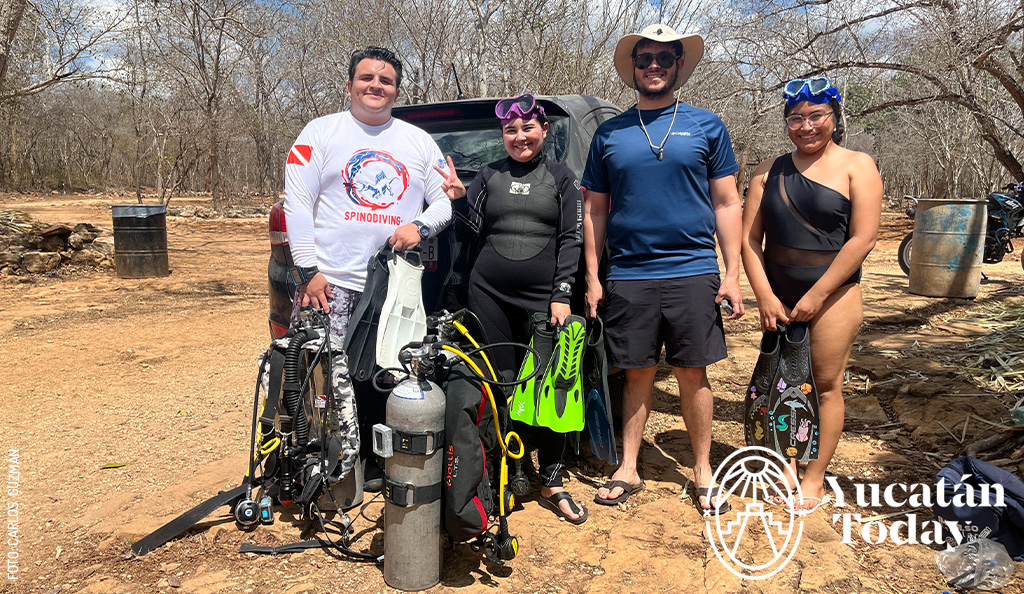
I had never scuba dived before, though I had snorkeled; in general, I consider myself skilled in the water, and I love cenotes. So, when I learned that this experience was possible, I didn't hesitate to sign up to discover that unknown world hidden in plain sight, beneath the water's surface.
Our guide for this adventure was Mario Macías, from Spino Diving, who has been diving for more than five years and is PADI-certified—PADI being the Professional Association of Diving Instructors. Mario picked us up right on time to take us to our destination: the Kankirixché cenote, near Abalá and Mucuyché, approximately an hour from the city of Mérida.
During the trip, he talked to us in depth about the years of experience they have at Spino Diving and the cenote diving tours they offer here in Yucatán. For our peace of mind, he reiterated the importance of always doing this type of activity with certified instructors; he even recommended never being afraid to ask your dive guide to show you their certification as an instructor. This will help ensure that the tour always adheres to the strictest safety standards.
Safety First: Scuba Theory and Gear Essentials
Like many extreme activities, diving carries some risks in exchange for an unforgettable, life-changing experience. That’s why it’s necessary to start with a little bit of theory—especially if, like us, you have never dived before. Mario took out the equipment and explained each piece and its operation in detail: tank, BCD (buoyancy control device), regulator, mask, fins—everything. We did tests to confirm the equipment was functioning well and finally answered a few questions to ensure we had all understood everything correctly.
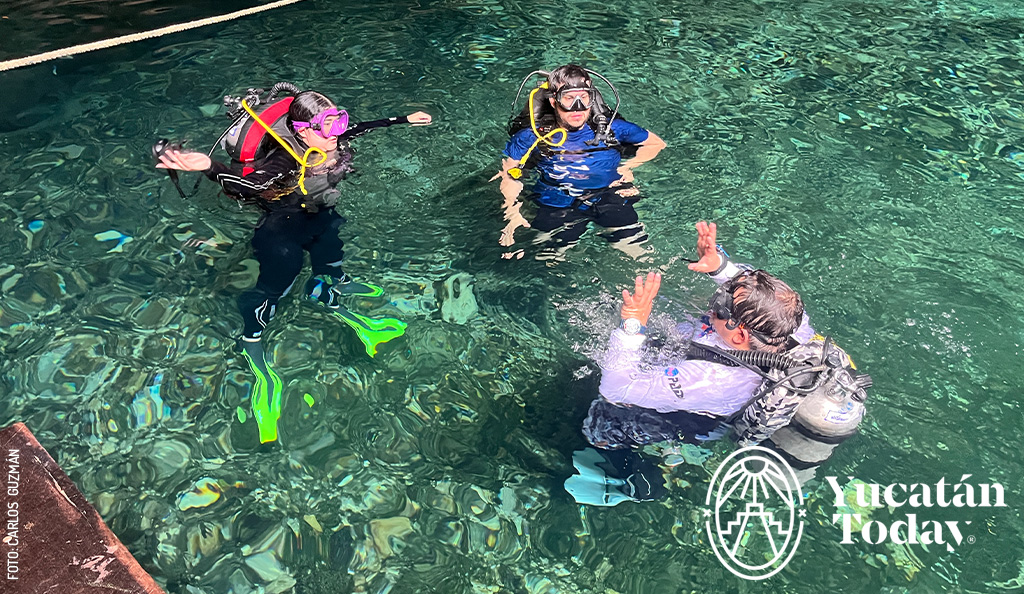
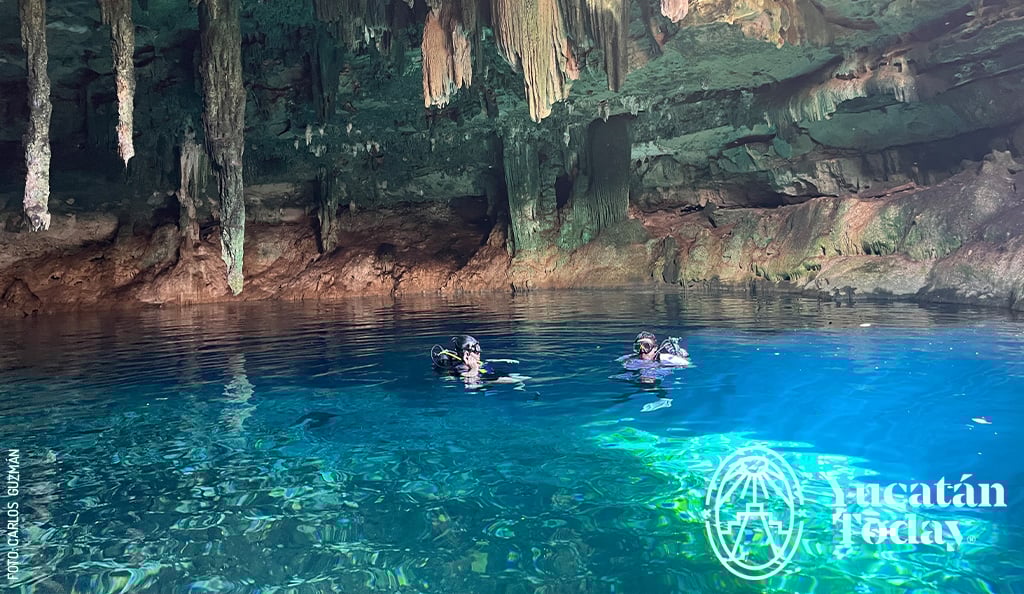
After the theory class, we put on the equipment and finally approached the water. Mario chose this cenote because it has very easy access for getting in and out of the water. Furthermore, being semi-open, the light that enters facilitates visibility inside the cave and, as we would discover later, allows for truly impressive views.
And while it was time to go into the cenote, we weren’t ready to dive just yet. We began with underwater exercises that simulate various situations that commonly happen while diving, and which are essential to stay safe at all times: things like recovering the regulator, clearing the mask, and inflating and deflating the BCD. We repeated all these exercises until we mastered them with the help of our instructor. He also taught us underwater signals to communicate during the dive later on.
Cenote Kankirixché, from within
Now the actual diving began. We descended slowly next to our instructor. I am sure I speak for everyone when I say that I was immediately stunned by the size of the cave, along with its majestic pillars and rock formations thousands and thousands of years old, illuminated by the beams of light passing through the water. The silence of the cenote, feeling the cave above me, the bluish clarity of the cenote, and the occasional fish also managed to surprise me. The enormity of an underground world.
It’s hard to explain just how small one feels when being in a cenote like this. And it is definitely different from snorkeling, or diving in the ocean, where the main attraction is the variety of species to see. Rather, diving in a cenote is about the marvel of feeling the perfect calmness while entering an ancient, thousand-year-old cave, ready to be explored—one that has been preserved over the centuries and has seen thousands and thousands of people come and go. And we were about to see proof of that.

Yucatán’s ancient underwater world
We advanced a few meters and approached a rock formation where Mario showed us something we definitely didn't expect: human bones peacefully resting on it. The fact is that that shouldn't surprise us, since cenotes are known for housing all kinds of archaeological objects, since they were sacred and very relevant places for Maya culture.
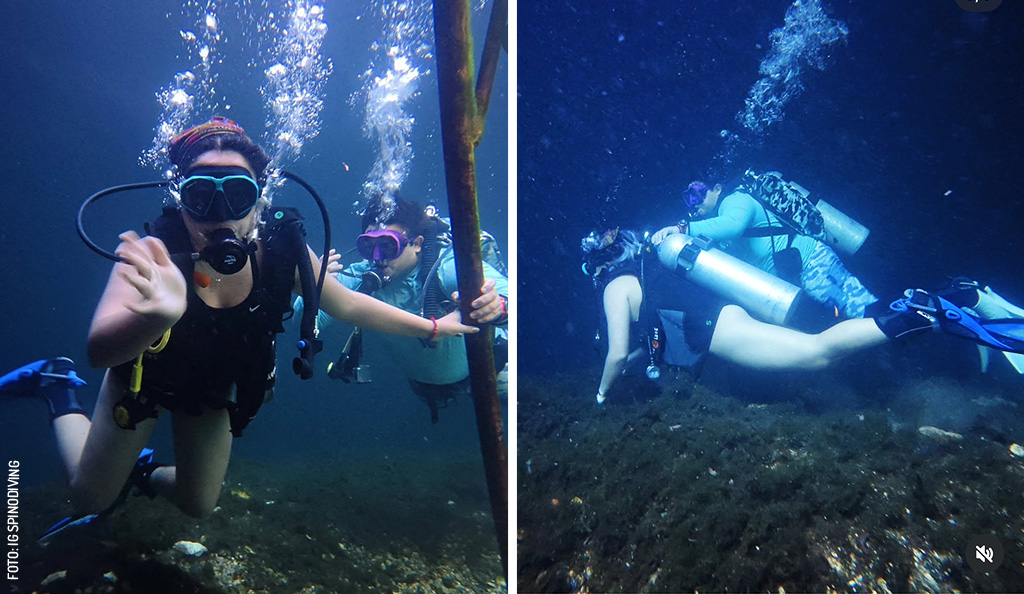
Much to our regret, the tour came to an end. After taking some photos, we slowly ascended, always next to Mario, who was looking out for us throughout the entire dive and confirming the well-being of everyone involved.
To finish, we left the cenote with the equipment, stored it, changed, and headed back to Mérida, our eyes heavy at times due to fatigue, but satisfied with our adventure. The snacks and drinks Mario provided for us hit the spot too. There is also the option to include a traditional meal in a nearby town, but you have to request that in advance when you book your tour.
If you’re wondering if diving in a cenote is for you, here’s my two cents: this tour is a physical activity that requires some strength, endurance, and composure. You don't have to be an athlete to dive, but being in shape definitely helps you feel safe, and the most important thing is to always keep calm; remember that it is an activity to enjoy and have fun.
The cenote diving experience with Spino Diving was a fascinating journey of immersion in an underground world— I can honestly say it more than exceeded my initial expectations as someone with no previous experience whatsoever. What began for me as a curiosity (with a tinge of nervousness) transformed into the discovery of a truly thrilling activity. Personally, I left the cenote with a huge desire to dive in again, and again accompanied and supported by the professionalism of someone like Mario.
Some common questions about cenote diving
Si nunca has buceado y no sabes qué es mejor para ti (o, por el contrario, si has buceado en el mar y quieres saber cuál es la diferencia), aquí te tenemos algunas respuestas. Elegir entre bucear en el mar o en un cenote es un dilema común; la respuesta, como en muchas cosas, es que depende. Como mencionamos antes, en el mar puedes disfrutar de la vida subacuática y su diversidad; el buceo en cenote te transporta a un mundo totalmente diferente y con una quietud invaluable. Además, el buceo en cenote te da la oportunidad de tener una experiencia más controlada ya que no hay olas, el agua es dulce y fresca y el nivel de visibilidad es mucho mejor— algo que, para tu primera vez, es ideal.
Cenote diving or ocean diving?
If you have never dived and don't know what is best for you (or, on the contrary, if you have dived in the sea and want to know what the difference is), here we have some answers for you. Choosing between diving in the sea or a cenote is a common dilemma; the answer, as in many things, is that it depends. As we mentioned before, in the ocean you enjoy underwater life and its diversity; cenote diving transports you to a totally different world and with an invaluable stillness. In addition, cenote diving gives you the opportunity to have a more controlled experience since there are no waves, the water is fresh, and the visibility is much better—which is especially helpful if it’s your first time diving.
When is the best time to dive in Yucatán?
To dive in the Gulf waters of the Emerald Coast in Yucatán, the best months are approximately from March to June. If you want to dive in a cenote, you can do it at any time of the year, although you always have to consider the weather conditions that may affect the clarity or the temperature of the water. If you have a specific date in mind, it never hurts to contact Spino Diving in advance so they can give you guidance on what you can expect by then.
What are the best cenotes to dive in according to your experience level?
Mario explained to us that often a single cenote can have areas for diving that are suitable for beginners and others for more experienced divers; thus, it will depend on your instructor to guide you through those that are appropriate for your own level. However, he did share some of the cenotes that he considers suitable to start with diving experiences:
- Cenote Noc Ac (between Mérida and Sierra Papacal)
- Cenote Noh-Mozón (Tecoh)
- Cenote Su-hem (Tecoh)
- Cenote Kankirixché (Abalá), which is where we went.
If you are already a more experienced diver, some with a higher level of difficulty could be the Dzombacal (in Umán), Nah Yah (Tecoh), or Yaal Utzil (Abalá) cenotes.
Discovery Experience in a cenote with Spino Diving
The tour we did with Mario and Spino Diving is called the Discovery Experience, and you don't need to be a certified diver to do it; you can even do it if you have never dived in your life before. Now, if you wish to get certified, you can definitely do it with Spino Diving, who offer a personalized experience from the first moment and adjust to your schedule and availability.
For Discovery experiences, Mario recommends coming with a group of no more than four people per instructor, to have greater control and care for the participants. The experience is 100% personalized for each group, so prices may vary, but the approximate cost is $3,000 pesos per person, which includes two immersions or diving sessions during the experience, in addition to including transportation from a meeting point in Mérida (like a hotel, park, shopping center, etc.) to the cenote you choose, plus snacks and drinks during the trip.
The experience takes approximately six hours, including transportation time, although this can also vary a lot depending on which cenote you choose and your party’s physical condition. Spino Diving also offers you flexibility in this sense, personalizing the time and schedule to accommodate you and your companions.
Finally, Spino Diving offers discounts or special packages for students and certified divers, as well as different courses and specializations. If this is something you’re curious about, don’t wait any longer: get in touch with them as soon as you can—you’ll still wish you had done it earlier.
Spino Diving
IG: spinodiving
55 3449 6392
By Gonzalo N. González and Sharon Cetina
First published in Yucatán Today print and digital magazine no. 460, in April 2026.


Related articles


